Smaller Plans, Louder Voices: What Young People Told Us Before the Protests
A data commentary from the FES Youth Studies
Since September, young people have been on the streets across Europe and beyond. In France, a movement that began at a high school in Créteil on September 21 spread to more than 350 schools within ten days. In Serbia, a list formed by the student protest movement won the parliamentary elections on October 25. There have been school and university protests over education funding in Belgium, Austria, Greece and Italy, over compulsory military service in Germany, over housing in Spain and Portugal, and over austerity and funding cuts in Argentina, Chile and Colombia. In the Guardian, Gordon Brown described it as the largest wave of student demonstrations in sixty years.
Much of the coverage has focused on the violence. In Limoges, rioters set fire to the 19th-century city hall, and its roof collapsed. In little more than two weeks of school blockades, there were more than 6,500 arrests, mostly of minors. The far right was quick to blame immigration. Marine Le Pen said France was "paying for decades of anarchic immigration," even though, as AFP reported, no link between the violence and immigration had been established. President Emmanuel Macron dismissed claims that France had been "invaded by hordes of migrants and Islamists" as "completely false."
The Friedrich-Ebert-Stiftung's Youth Studies allow us to ask a different question: what do young people themselves think and want? In Southeast Europe, we surveyed young people in 2018 and again in 2024, which allows us to follow ten countries over six years. In Latin America, we surveyed young people in fourteen countries in late 2023 and early 2024. All the surveys took place before the current wave of protests, so they cannot explain any particular demonstration. What they do show is how young people's expectations and their willingness to act changed in the years leading up to it. Unless noted otherwise, the figures below refer to young people aged 15 to 29, and regional figures give each country equal weight.
Lower expectations
Between 2018 and 2024, young people in Southeast Europe rated almost every personal goal we asked about as less important. The share who said a successful career was important to them fell from 85 to 76 percent. Having children fell from 84 to 74 percent, getting married from 76 to 63 percent, and getting rich from 65 to 53 percent. Even being independent and taking responsibility, which nearly everyone valued in 2018, lost nine and thirteen points. These declines are not confined to a few countries: the importance of a career and of a university degree fell in all ten countries, and the importance of having children in nine.
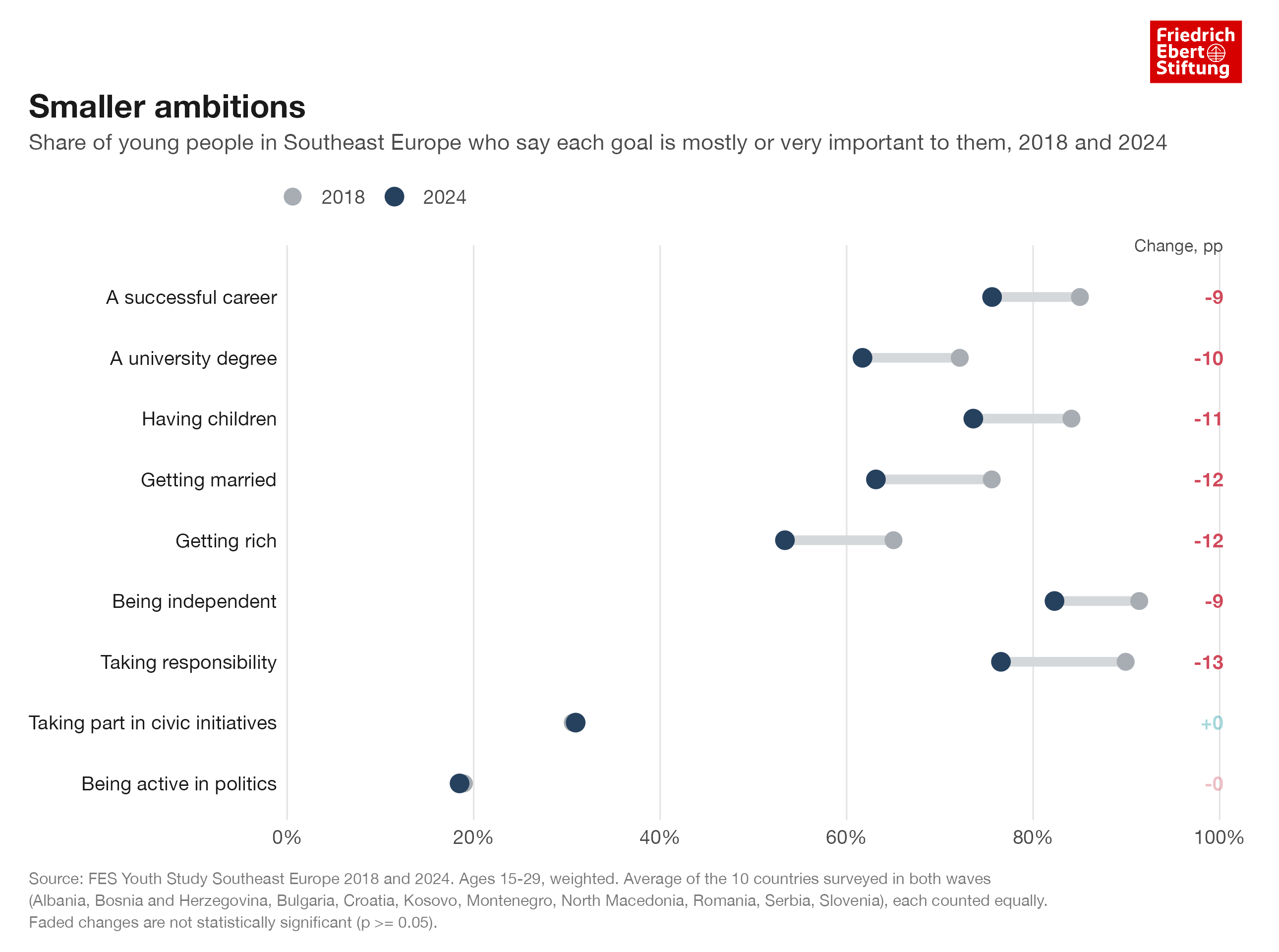
Young people did not swap one goal for another. Career and family fell together, and a growing group rated neither as important, a pattern we described in more detail in Part 7 of our Gender Gap series. It looks less like a change in values than a scaling back of what young people expect to achieve.
Their view of the world around them darkened at the same time. Most still expect their own lives to improve over the next ten years (82 percent, down from 85), but the share who expect their country's future to be worse rose from 21 to 32 percent. Fears increased across the board. The share who fear war "a lot" rose from 29 to 51 percent, serious illness from 40 to 54 percent, physical violence from 24 to 40 percent, and having no job from 44 to 52 percent. Among the fears asked about for the first time in 2024, a bad healthcare system tops the list at 62 percent, followed by not having a decent pension (50 percent), and housing problems (42 percent). Material conditions also worsened for a part of this generation: the share living in households that cannot afford clothes and shoes rose from 12 to 16 percent, and the share without a job and looking for one from 15 to 19 percent.
More voice, not less
Lower expectations might be expected to produce withdrawal: young people who give up on politics, or who look for a strong leader to fix things. The data show the opposite. Over the same six years, young people in Southeast Europe became more politically active on almost every measure we have.
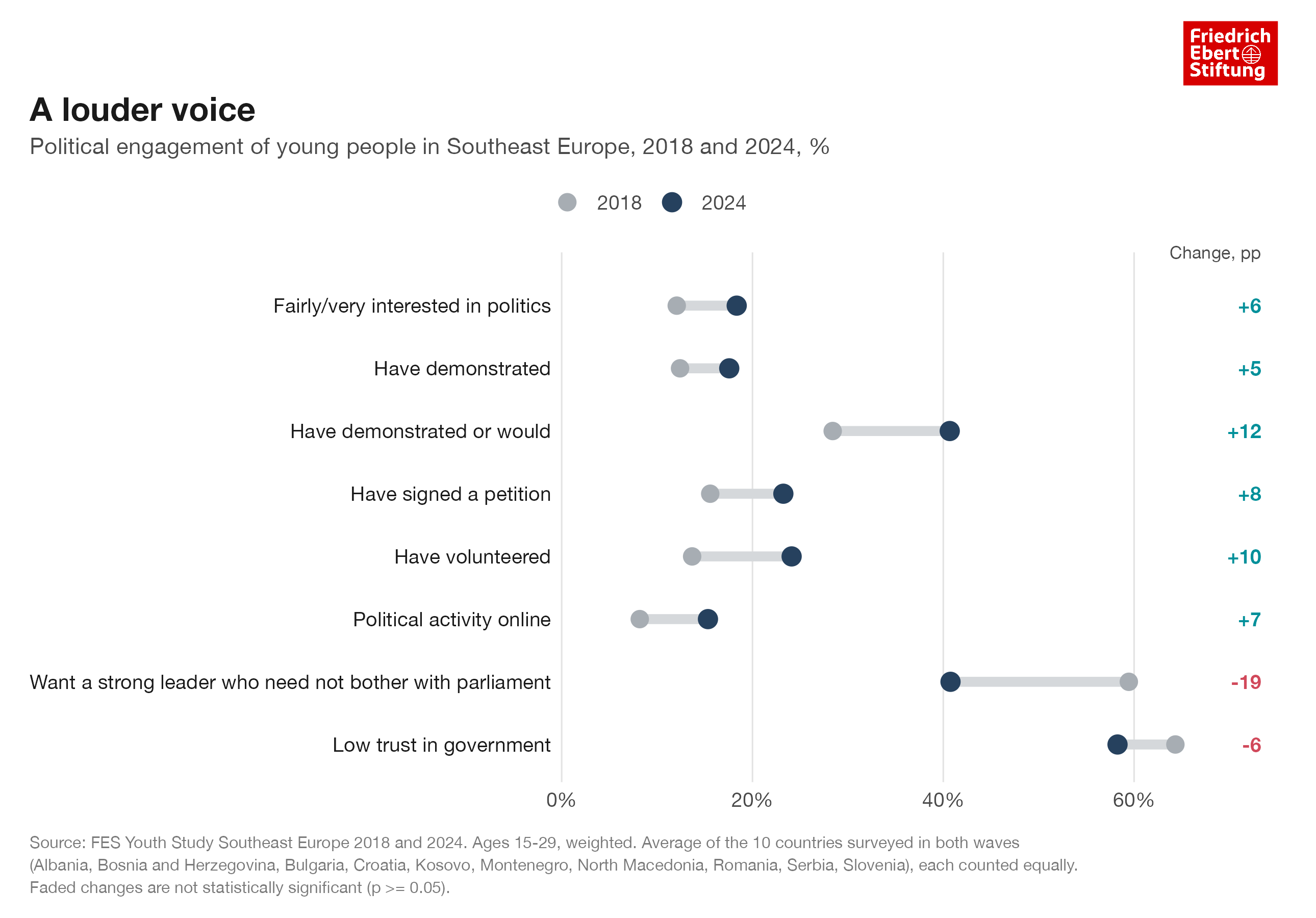
The share who had taken part in a demonstration or would be willing to rose from 28 to 41 percent. The share who had actually demonstrated rose from 12 to 18 percent. Volunteering went from 14 to 24 percent, signing petitions from 16 to 23 percent, boycotts from 8 to 23 percent and political activity online from 8 to 15 percent. Interest in politics also grew, from 12 to 18 percent who are fairly or very interested. At the same time, support for "a strong leader who does not have to bother with parliament and elections" fell from 59 to 41 percent, and fell in nine of the ten countries.
Two caveats apply. First, the rise in protest potential was uneven: it was large in Croatia, Montenegro, Romania and Bosnia and Herzegovina, and small or absent in Bulgaria, Kosovo and North Macedonia. Second, the countries where pessimism grew most were not always those where protest potential grew most. Bulgaria became much gloomier without becoming more willing to protest; Montenegro became more willing to protest without becoming gloomier. Across the region the two trends run in parallel, but the data do not show that one causes the other.
Who protests
The question of who takes to the streets matters for how governments respond. Our 2024 data cover 26 countries and more than 24,000 young people, and they allow us to compare those who have taken part in a demonstration with those who have not.
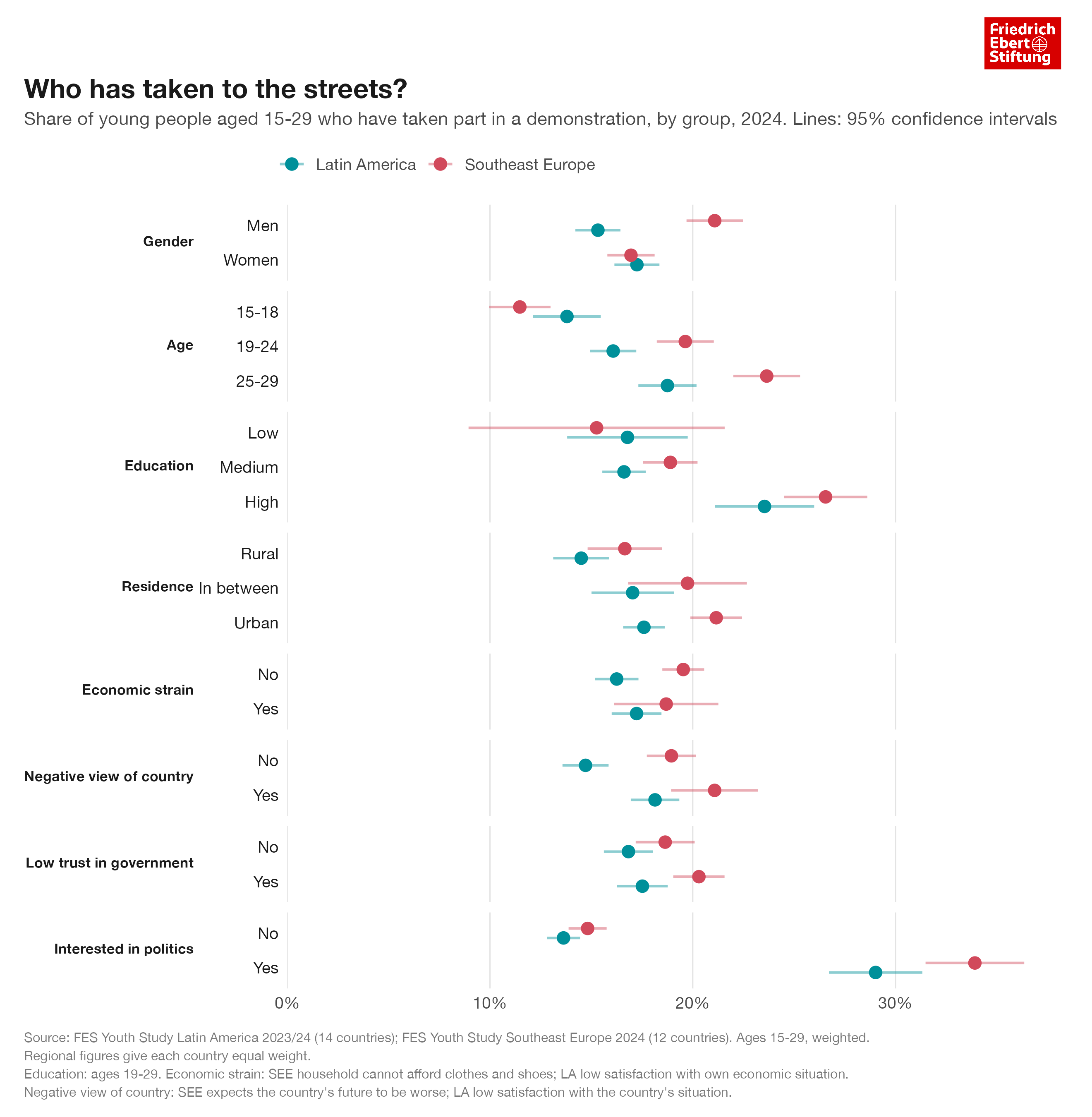
The strongest single factor is interest in politics. Young people who are fairly or very interested in politics are about twice as likely to have demonstrated as those who are not: 29 against 14 percent in Latin America, and 34 against 15 percent in Southeast Europe. Education also matters. Among those aged 19 to 29, university graduates are more likely to have protested than those with less education, in both regions. City dwellers are somewhat more likely to have protested than young people in rural areas. These differences hold when we compare young people of the same age, gender, education and country in a statistical model.
Several factors that are often assumed to drive protest make little or no difference. Young people who struggle financially are no more likely to have demonstrated than those who do not. Low trust in the government makes no significant difference either. A negative view of the country's situation raises the probability of having protested by about two percentage points, a small effect next to that of political interest (14 to 16 points).
Gender works differently in the two regions. In Latin America, young women are slightly more likely than young men to have demonstrated (17 against 15 percent). In Southeast Europe, the reverse is true (17 against 21 percent). In neither region is protest a predominantly male activity.
Our surveys do not ask about migrant background, so they cannot test claims about the origin of protesters in any particular country. What they show is that the young people who protest are, on average, better educated, more urban and more interested in politics than their peers. That profile is hard to reconcile with the idea that protest is mainly the work of a marginalized minority with nothing to say.
Why they go, and why others stay home
The Latin American survey asked young people who had taken part in a march or protest in the previous year what motivated them, and asked those who had not why they stayed away. About 15 percent had protested in the past year.
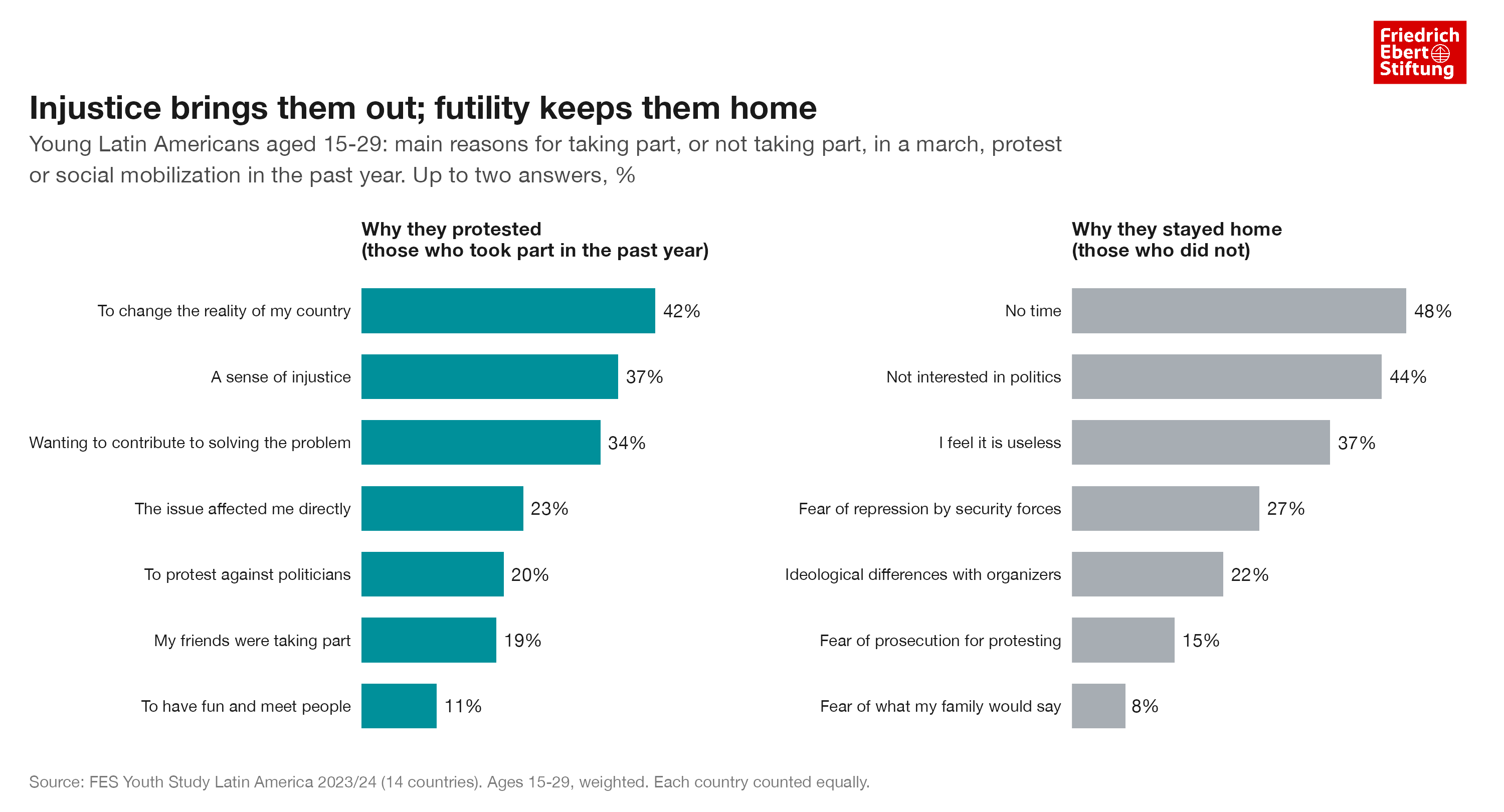
The most common reason for taking part was to change the reality of their country (42 percent), followed by a sense of injustice (37 percent) and the wish to contribute to solving a problem (34 percent). Among those who did not protest, the most common reasons were lack of time (48 percent) and lack of interest in politics (44 percent). More than a third (37 percent) said protest is useless, and more than a quarter (27 percent) cited fear of repression by the security forces, a fear more common among young women (31 percent) than young men (23 percent).
The grievances behind this are largely material. Asked to name the three main problems facing young people in their country, 60 percent of young Latin Americans chose poverty, unemployment and lack of access to health and education, far ahead of any other answer. In Southeast Europe, the issues young people expect to dominate the next decade are corruption (60 percent), unemployment (58 percent), the emigration of skilled workers (53 percent) and the quality of public services (48 percent). Work offers limited security: among young Latin Americans who have a job, only 39 percent work full time with the benefits the law requires.
Many also think about leaving. More than half of young Latin Americans (56 percent) say they would like to emigrate, most often to experience something different, because of the economic crisis or for lack of work. In Southeast Europe, 28 percent have a strong wish to emigrate. Those who want to leave are, if anything, slightly more willing to protest than those who want to stay (48 against 41 percent in Latin America, 48 against 44 percent in Southeast Europe). For many young people, leaving and speaking up do not appear to be alternatives.
Young protesters are also not turning against democracy. In Southeast Europe, 58 percent of those who have demonstrated say democracy is always preferable to other forms of government, compared with 52 percent of those who have not. In Latin America, the figures are 82 and 78 percent.
What this means
The survey data support a reading of the current protests that differs from much of the coverage. Over the past several years, young people in Southeast Europe have lowered their expectations for their own lives, grown more pessimistic about their countries and more fearful about jobs, health, security and war. They have not withdrawn from politics in response. They have become more interested, more active and less attracted to strong-man solutions. The young people who protest are, for the most part, politically engaged, educated and motivated by a sense of injustice and a wish to change their countries.
For policymakers, this has three implications. First, treating the protests mainly as a public order problem misreads who is protesting and why, and risks confirming the conclusion that many non-protesters have already reached, that speaking up is useless. Second, the grievances are concrete: jobs, decent work, housing, public services, health care and pensions, the areas where young people's fears have risen most. Responses that address these issues are more likely to restore confidence than appeals to calm. Third, a generation that is more willing to act and less willing to accept authoritarian shortcuts is a resource for democracy, not a threat to it. Whether that remains true depends on whether institutions give young people reasons to believe that participation changes something.
About the Data
This commentary draws on three surveys conducted by the Friedrich-Ebert-Stiftung. The Southeast Europe Youth Study 2018 and 2024 surveyed young people aged 14 to 29; trends compare the ten countries included in both waves (Albania, Bosnia and Herzegovina, Bulgaria, Croatia, Kosovo, Montenegro, North Macedonia, Romania, Serbia and Slovenia), with 10,411 respondents aged 15 to 29 in 2018 and 6,310 in 2024. The 2024 analyses also include Greece and Türkiye (8,336 respondents aged 15 to 29). The Latin America Youth Study was conducted between December 2023 and February 2024 in Argentina, Bolivia, Brazil, Chile, Colombia, Costa Rica, the Dominican Republic, Ecuador, Honduras, Mexico, Panama, Peru, Uruguay and Venezuela (16,178 respondents aged 15 to 29; the Latin American survey also interviewed people aged 30 to 35, who are not included here). All estimates are weighted, and regional figures give each country equal weight. The changes over time and the group differences in the model of who protests that are described in the text are statistically significant at the 95 percent level. The analysis of who protests uses survey-weighted logistic regression with controls for gender, age, education, place of residence and country. Some measures differ between the two regions: economic strain refers to household purchasing power in Southeast Europe and to satisfaction with one's own economic situation in Latin America, and a negative view of the country refers to expectations for its future in Southeast Europe and to satisfaction with its current situation in Latin America.
Related publication

Hasanović, Jasmin ; Lavrič, Miran ; Adilović, Emina ; Stanojević, Dragan
Youth study Southeast Europe 2024
independent but concerned: the voices of young people in Southeast Europe
See the full list of youth study publications