The Gender Gap Report Part 7: Future Families
How Gender Shapes Views on Children, Marriage, and Life Goals
Southeast Europe is in the grip of a demographic crisis. Fertility rates across the region have fallen well below the replacement level of 2.1 children per woman, and several countries face some of the sharpest projected population declines anywhere in the world. By 2050, Bulgaria is expected to have nearly 39 % fewer people than it did in 1990, Serbia around 24 % fewer, and Croatia over 22 % fewer.. Bosnia and Herzegovina’s fertility rate of 1.26 places it among the lowest globally. The combination of collapsing birth rates, rapid ageing, and sustained emigration of young people has led analysts to describe the Western Balkans as facing one of the world's most severe depopulation crises.
These trends have not gone unnoticed by politicians. Across the region, governments have begun experimenting with pronatalist policies—often drawing explicit inspiration from Hungary's Family Protection Action Plan, launched in 2019, which combined subsidised loans for married couples, tax exemptions for mothers of multiple children, and housing grants scaled to family size. Hungary now spends around 5% of GDP on family subsidies, yet its fertility rate has barely risen beyond 1.6—and has fallen again since 2022. Nevertheless, the Hungarian model has found admirers across the Balkans. Serbia has tripled cash incentives for first-born children and introduced housing subsidies for young families, with President Vučić framing demographic decline as an existential national threat. Greece has announced plans to spend €20 billion through 2035 on measures including cash benefits, childcare vouchers, and tax breaks. These developments reflect a broader pattern in which demographic anxiety has risen to the top of the political agenda across the region.
But what do young people themselves actually want? The political debate often proceeds as though the problem is one of values—that young people, and especially young women, have turned away from family life in favour of career and mobility. The Friedrich Ebert Stiftung's 2024 Youth Study allows us to test this assumption directly. When it comes to how many children young people want, men and women across Southeast Europe are remarkably aligned: young men plan to have an average of 1.78 children while young women plan 1.80—a difference so small it could easily be due to chance. This convergence in family size aspirations stands in contrast to the persistent gender gaps documented elsewhere in this series—and suggests that the barriers to family formation may lie not in what young people want, but in the conditions they face.
This seventh installment in our Gender Gap series examines how young Southeast Europeans think about building families—and how those views have changed since the FES Youth Study conducted in 2018. It reveals a generation where the question is less about whether men and women want different things, and more about when they want them and what else they want alongside them.
The Two-Child Consensus
Across Southeast Europe, young people of both genders converge on a clear preference: two children. About 40% of both young men (39.7%) and young women (41.2%) plan to have exactly two children, making this the dominant family size aspiration by a wide margin.
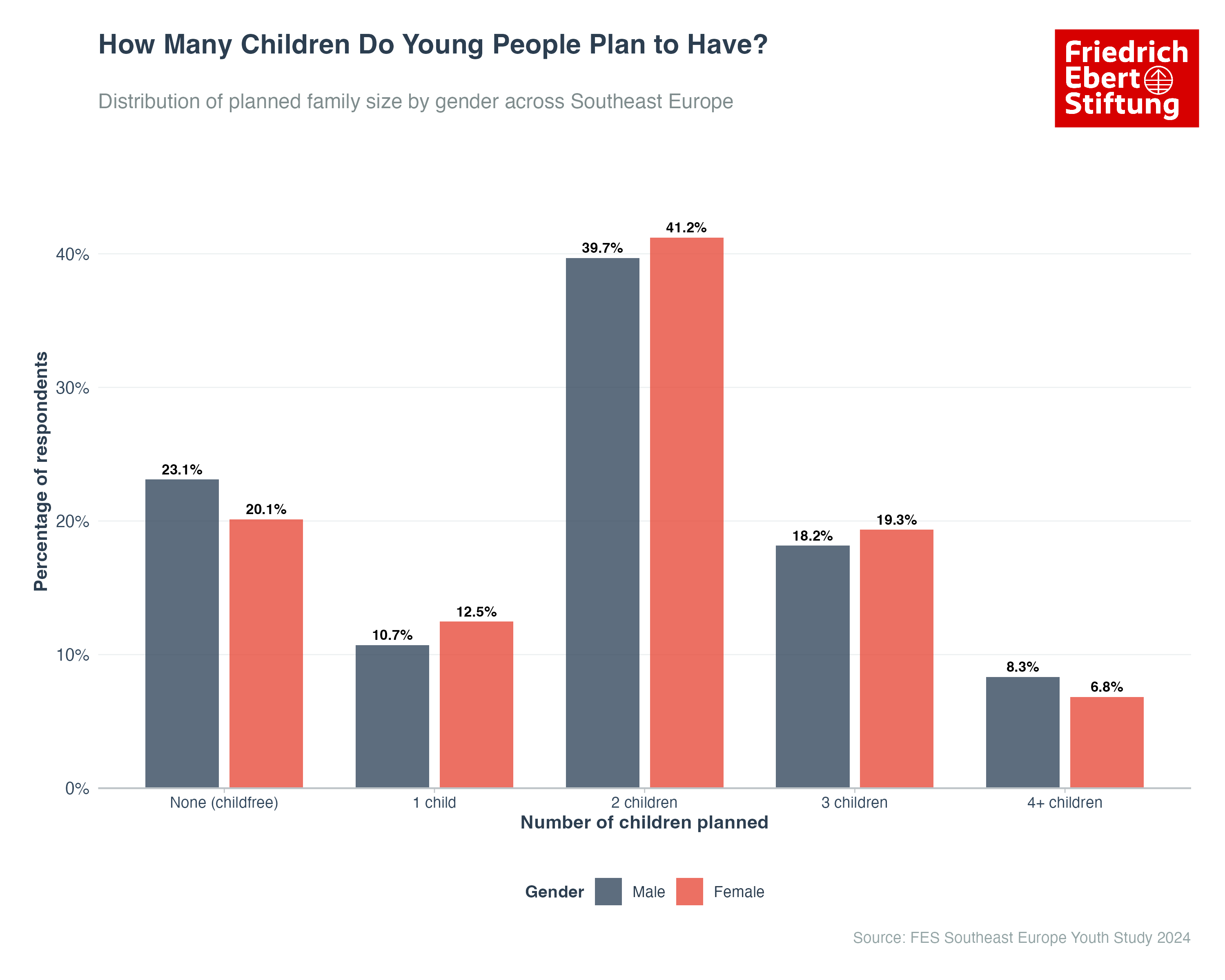
The distribution is similar across genders. Young men are slightly more likely to plan for no children (23.1% versus 20.1%) and for four or more children (8.3% versus 6.8%), while young women show marginally higher rates for one child (12.5% versus 10.7%) and three children (19.3% versus 18.2%). But none of these differences reach statistical significance—the overall gender gap in average children planned is just 0.02.
This convergence is worth noting given the gender gaps documented elsewhere in this series. On questions of political leadership, employment rights, and partner preferences, young men and women often inhabit different attitudinal worlds. On family size, they largely agree.
The Timing Divide: When Men Want to Wait
Where gender gaps do emerge is in the timing of parenthood. Nearly half of young men (49.5%) plan to have their first child at age 26 or later, compared to 42.5% of young women. This 7 percentage point gap is statistically significant.
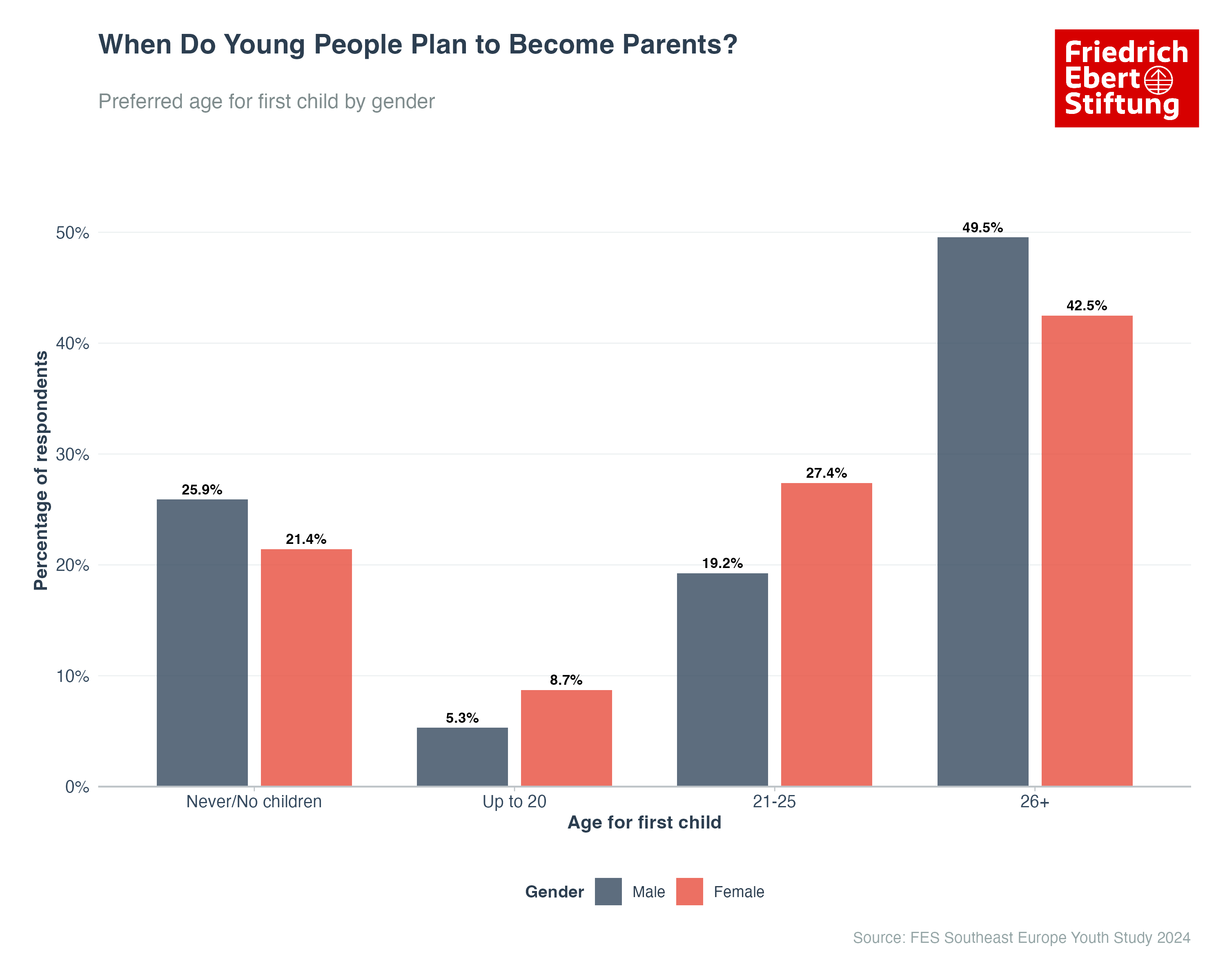
Young women show a more distributed pattern across timing preferences. They are more likely than men to envision becoming parents in their early-to-mid twenties (27.4% planning for ages 21-25, versus 19.2% of men) or even before age 20 (8.7% versus 5.3%). This creates a gap in expected parental trajectories: young women who want children tend to envision starting earlier than their male peers.
The pattern likely reflects biological realities—women face age-related fertility constraints that men do not—but also potentially different expectations about life sequencing. While young men more often assume they will complete education, establish careers, and then start families, young women more often expect to navigate these milestones concurrently or in different order.
Life Priorities: Women Want More of Everything
Perhaps the most important finding concerns life priorities more broadly. When asked how important various life goals are to them, young women rate nearly every priority higher than young men do—including both career-oriented and family-oriented goals.
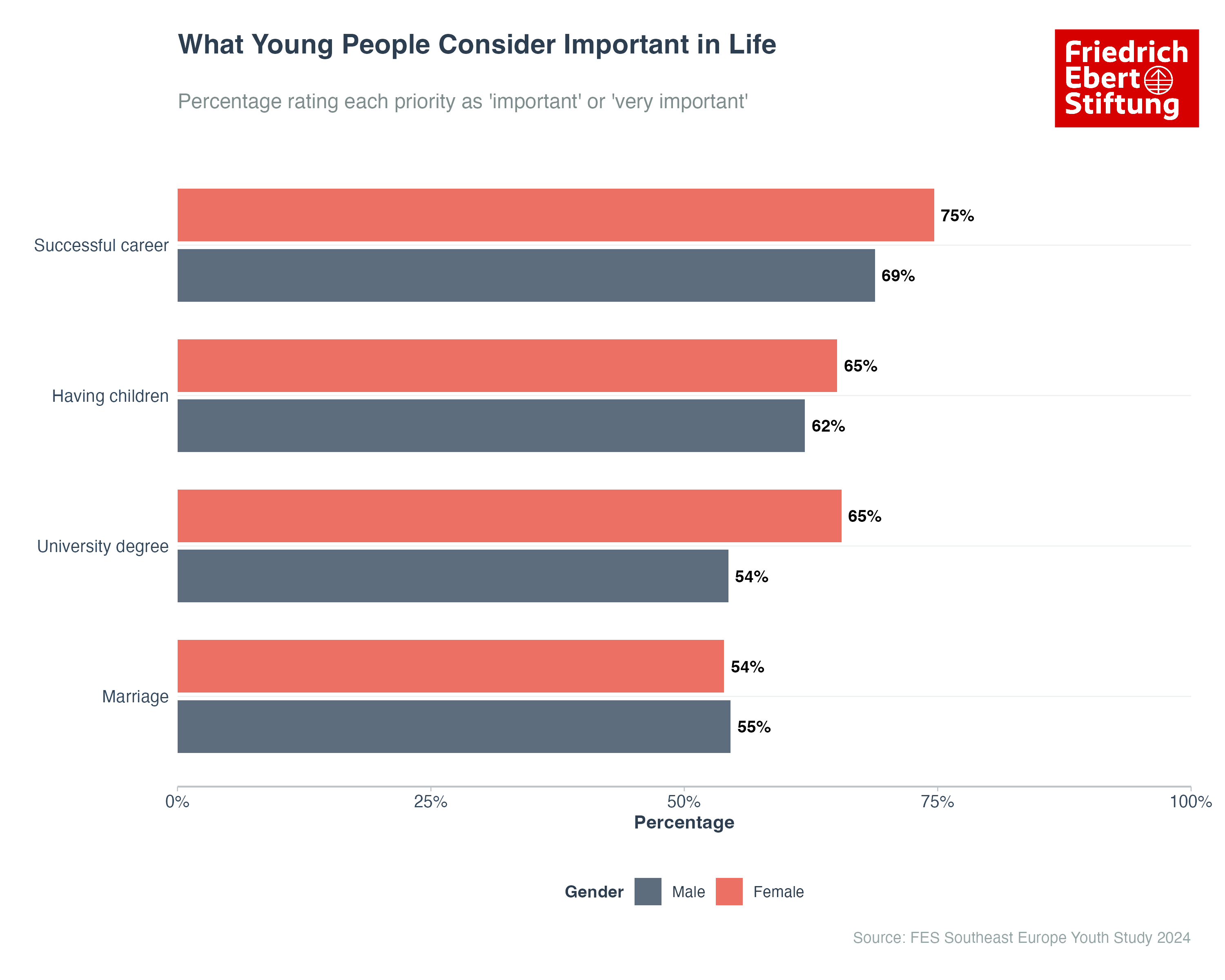
Three-quarters of young women (75%) rate having a successful career as important or very important, compared to 69% of young men—a significant 6 percentage point gap. The gap is even larger for obtaining a university degree: 65% of women versus 54% of men, an 11 percentage point difference that represents one of the largest gender gaps in this analysis.
But young women do not trade family aspirations for career ambitions. They also rate having children as more important than men do (65% versus 62%, statistically significant). Only on marriage do the genders essentially converge, with men actually showing marginally higher importance ratings (55% versus 54%, not statistically significant).
This pattern challenges simple narratives about women choosing between career and family. Young women in Southeast Europe are not deprioritizing family to focus on careers—they are expressing higher ambitions across multiple life domains simultaneously.
Priority Profiles: Who Wants It All?
To understand how these priorities combine, we classified young people into four profiles based on whether they rated family goals (marriage and children) and career/education goals as high priorities. The results reveal that young women are more likely than young men to prioritize everything—and less likely to prioritize nothing.
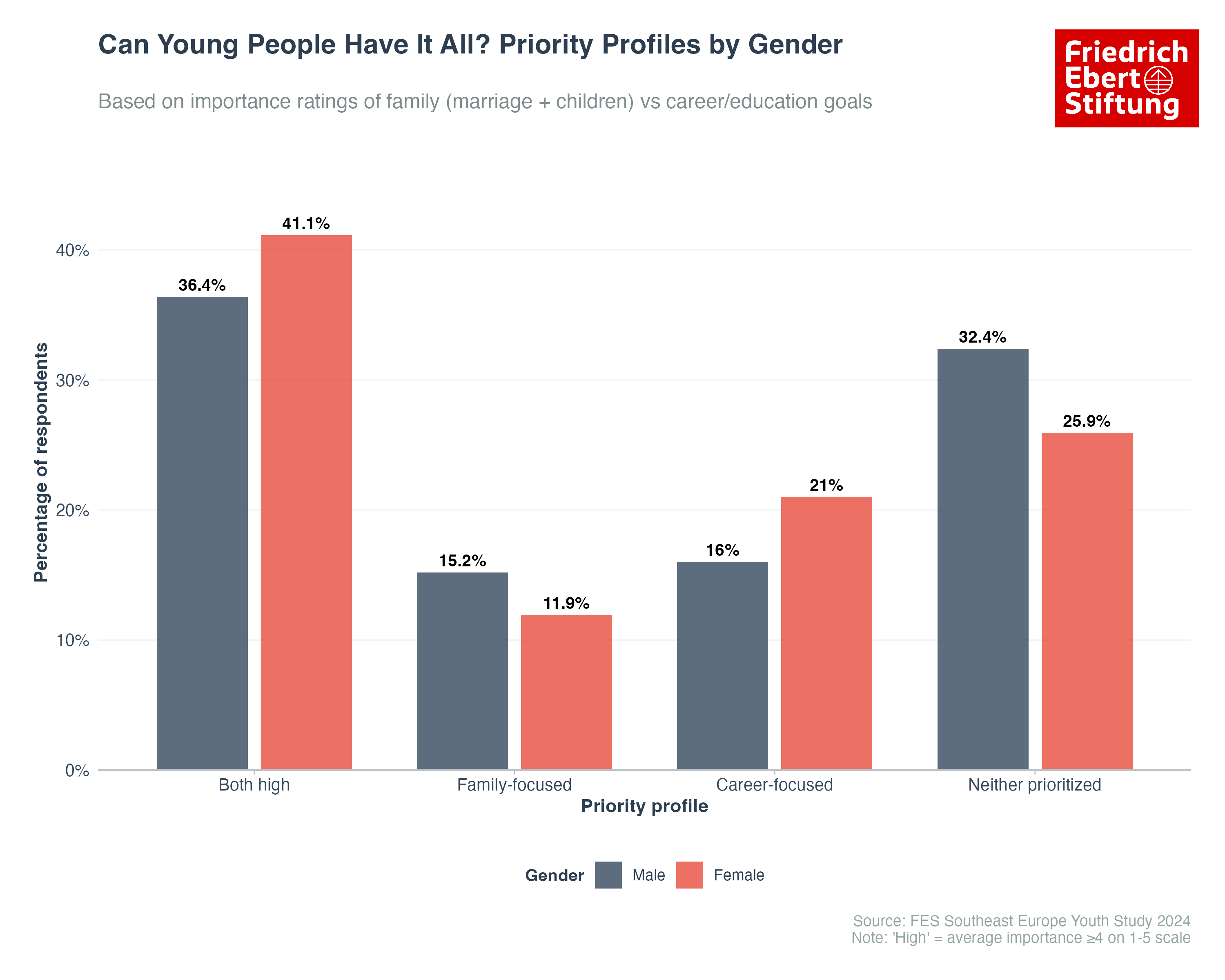
Over 41% of young women fall into the "both high" category, rating both family and career/education as important, compared to 36% of young men. Meanwhile, nearly a third of young men (32.4%) fall into "neither prioritized," compared to just over a quarter of young women (25.9%). The overall distribution of priority profiles differs significantly by gender.
Young women are also more likely to be career-focused without high family priorities (21% versus 16%), while young men are more likely to be family-focused without high career priorities (15% versus 12%). But the dominant pattern is that women are more likely to want both, and men are more likely to express lower investment across the board.
The data suggests that what distinguishes young women from young men is not that they want different things, but that they want more things—expressing higher ambitions across multiple domains rather than choosing between them.
Age Patterns: Marriage Views Diverge Over Time
How do family values evolve as young people move from adolescence into adulthood? The patterns differ for marriage versus children, and differ by gender in unexpected ways.
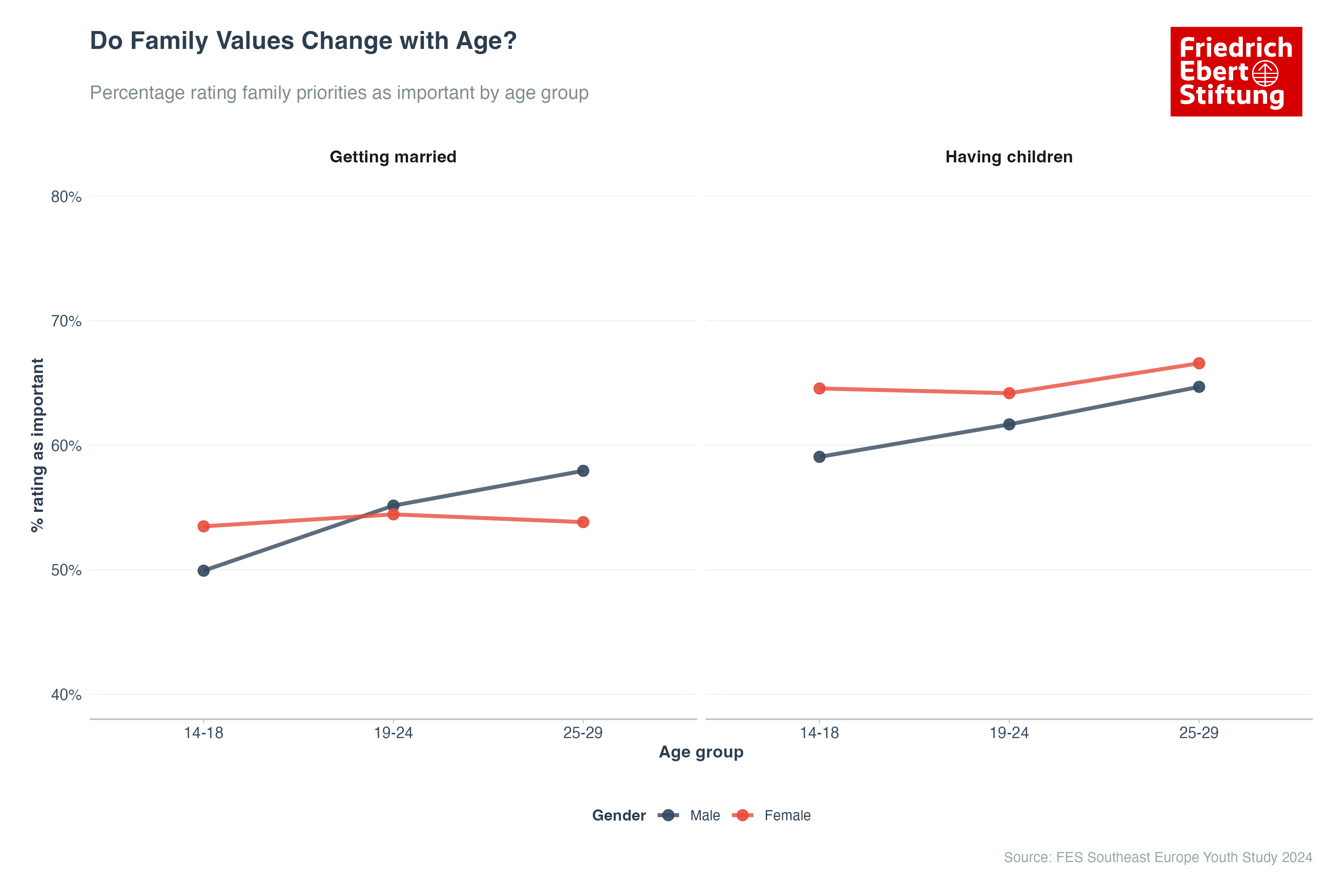
For attitudes toward having children, both genders show similar trajectories—importance increases modestly with age, with women consistently rating children as more important across all age groups. The gender gap remains relatively stable.
Marriage shows a more complex pattern. Among 14-18 year olds, men and women express similar importance ratings. But as they age, men's marriage importance increases substantially (from about 50% to 58%), while women's remains flat or even declines slightly. By ages 25-29, young men rate marriage as more important than young women do.
This divergence over time could reflect different experiences entering adulthood. Young men may become more marriage-oriented as they achieve economic stability and readiness to settle down. Young women, meanwhile, may become more ambivalent about marriage as they encounter its practical realities or develop stronger independent identities. Whatever the cause, the pattern suggests that gender gaps in marriage attitudes widen rather than narrow as youth mature.
The Geography of Family Aspirations
While gender gaps in family size preferences are modest, country differences are significant. Young people in Kosovo plan to have nearly three children on average, while those in Slovenia plan barely more than one—a gap far larger than any gender difference within countries.
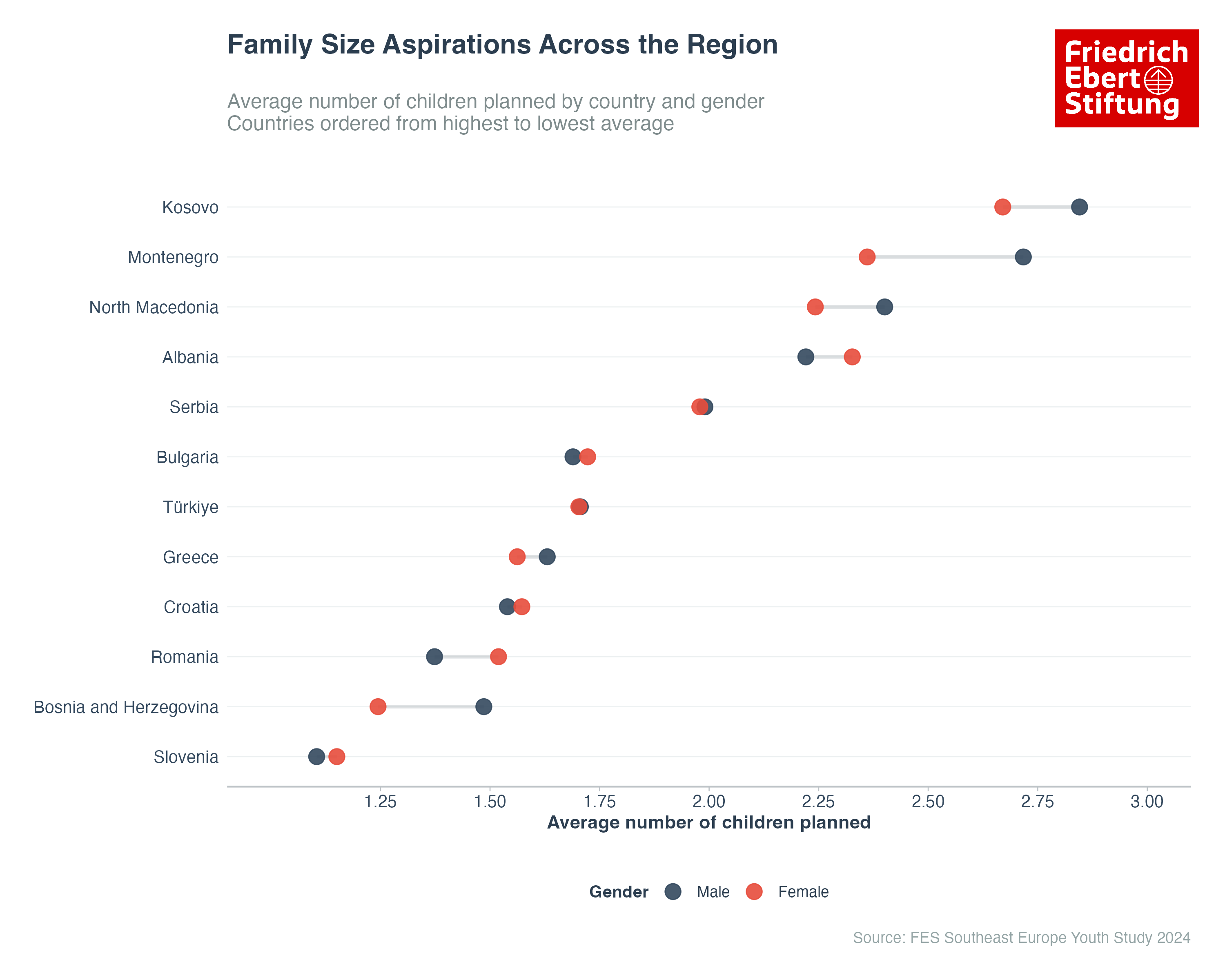
Kosovo stands out with the highest family size aspirations in the region (2.85 children for men, 2.67 for women), followed by Montenegro and North Macedonia. At the other end, Slovenia shows the lowest aspirations (1.10 for men, 1.15 for women), with Bosnia and Herzegovina and Romania also below 1.5 children.
The gender gap within countries varies as well. In most countries with higher overall aspirations—Kosovo, Montenegro, North Macedonia—men plan for slightly more children than women. In several countries with lower aspirations—Romania, Croatia, Slovenia, Albania—women actually plan for slightly more children than men. But these within-country gender gaps are generally modest compared to the between-country variation.
Emigration and Family Planning: Leaving Means Smaller Families
Does wanting to leave one's country affect family planning? The data suggests it does—those with strong desires to emigrate plan for smaller families, and this pattern is particularly pronounced for young women.
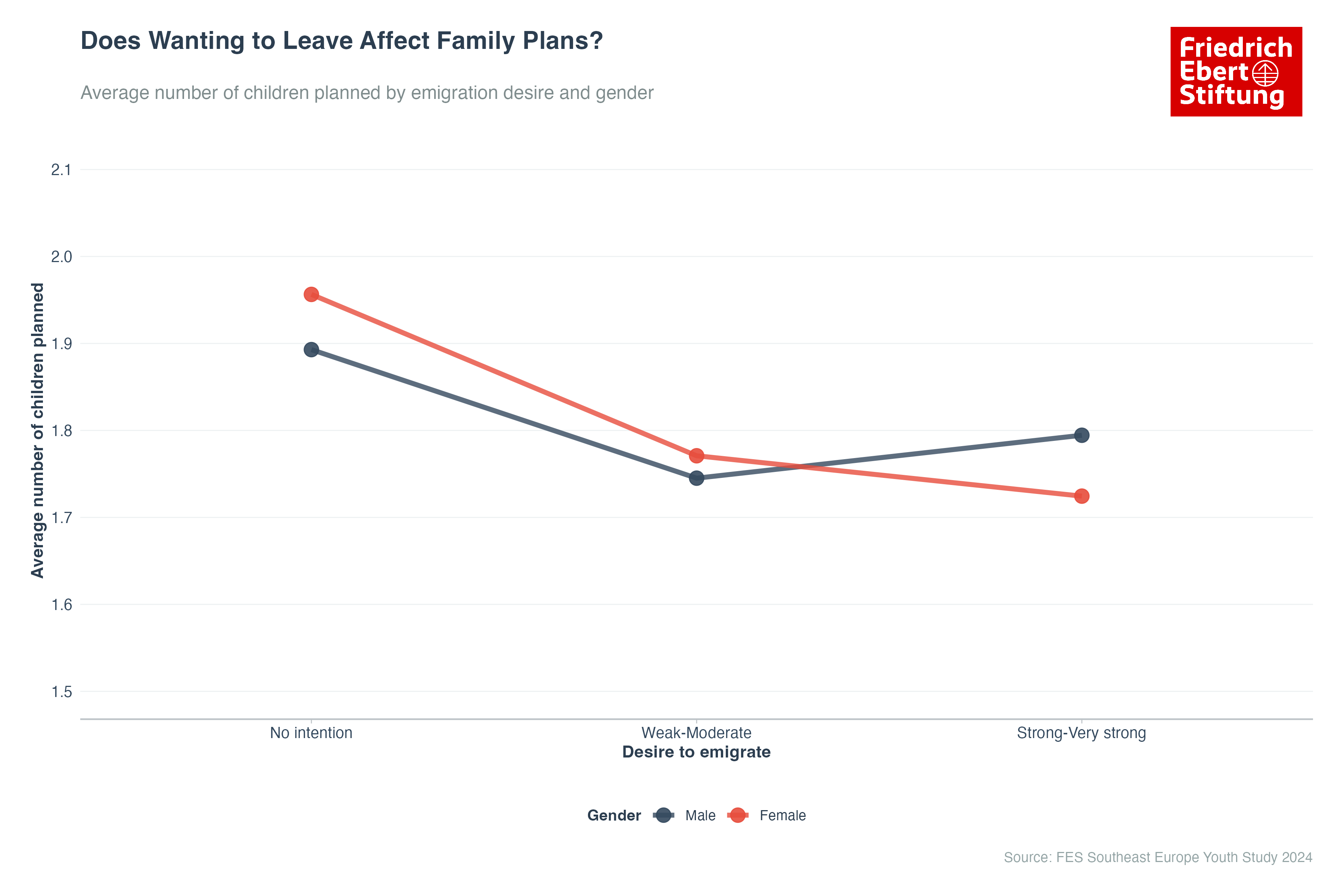
Young people with no intention to emigrate plan for the largest families—an average of 1.96 children for women and 1.89 for men. Those with moderate emigration desires plan fewer (1.77 for women, 1.75 for men). And among those with strong emigration desires, family plans shrink further, with women planning just 1.72 children on average.
What is notable is how the gender gap reverses across emigration categories. Among those with no emigration desires, women plan for more children than men. Among those with strong emigration desires, men plan for more children than women. This suggests that emigration aspirations may be particularly associated with reduced family size expectations among young women—perhaps because international migration is seen as less compatible with larger families, or because women who prioritize mobility also prioritize other goals over family size.
The overall emigration effect is statistically significant, though the interaction with gender is not strong enough to reach conventional significance thresholds. Still, the pattern suggests that the relationship between geographic mobility and family formation may be gendered in ways that merit attention from policymakers concerned about both emigration and fertility trends.
How Views Have Changed Since 2018
The 2024 findings take on additional significance when compared with the previous wave of the FES Youth Study, conducted in 2018. Restricting the comparison to the ten countries surveyed in both waves—and thus excluding Greece and Türkiye, which were added in 2024—reveals that young people today rate nearly every life priority as substantially less important than their counterparts did six years ago. This decline is not confined to family goals or career goals; it spans all domains measured.
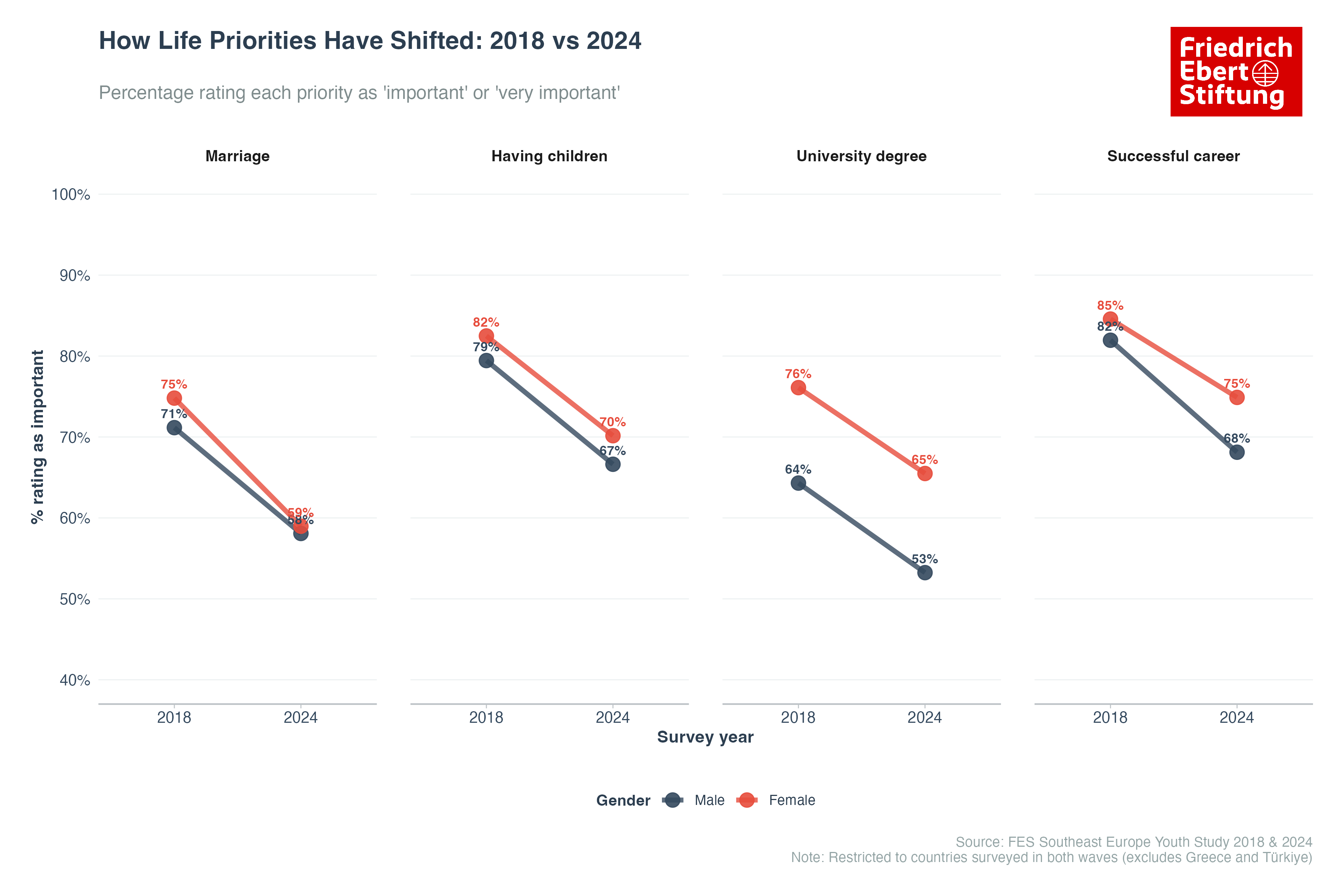
The share of young men rating a successful career as important fell from 82% in 2018 to 68% in 2024—a 14 percentage point drop. For young women, the decline was smaller but still substantial, from 85% to 75%. Having children saw similar drops: down 13 points for men (79% to 67%) and 12 points for women (83% to 70%). Marriage showed the steepest decline among women, falling 16 percentage points (from 75% to 59%), compared to 13 points for men—a statistically significant interaction, suggesting that young women's enthusiasm for marriage has cooled faster than young men's. The importance of obtaining a university degree also fell by roughly 11 points for both genders. All of these year effects are highly statistically significant.
The Rise of "Neither": Priority Profiles Over Time
The shift in priority profiles tells this story even more starkly. In 2018, a majority of young women (60%) and half of young men (51%) fell into the "both high" category—rating both family and career goals as important. By 2024, these figures had dropped to 45% and 38% respectively, declines of roughly 13–15 percentage points.
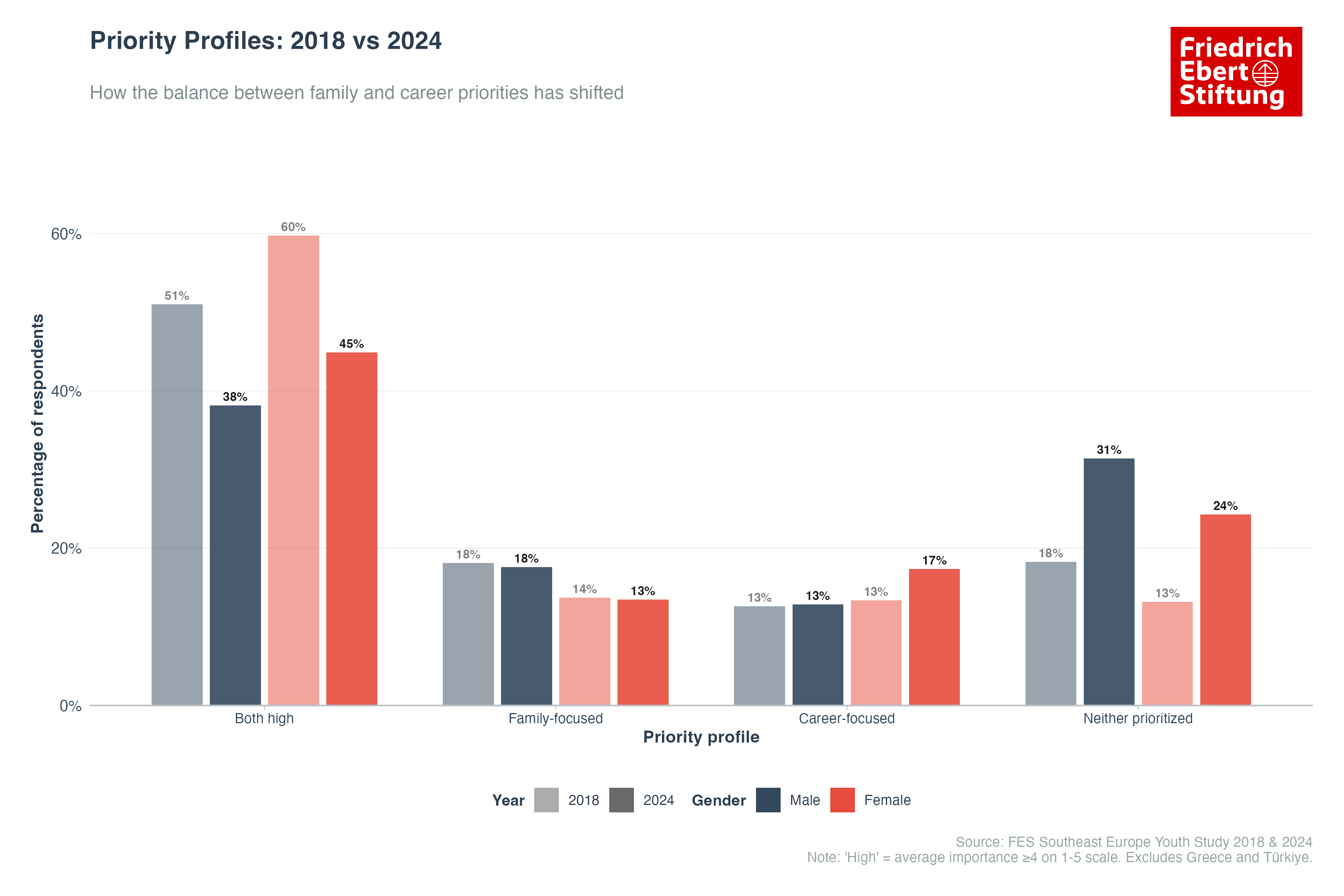
Where did these young people go? Overwhelmingly into the "neither prioritized" category. The share of young men expressing low investment in both family and career goals nearly doubled, from 18% to 31%. Among young women, the shift was even more dramatic in proportional terms—from 13% to 24%. Meanwhile, the "family-focused" and "career-focused" profiles remained largely stable, with one exception: the share of career-focused women rose modestly from 13% to 17%, suggesting that some young women who previously aimed for both have shifted toward prioritising career alone.
This pattern challenges simplistic interpretations of demographic decline. If the story were that young people—especially young women—are choosing careers over family, we would expect to see the career-focused profile growing at the expense of the family-focused profile. Instead, the dominant shift is from "wanting both" to "expressing lower importance for everything." This is more consistent with disillusionment or declining expectations than with a deliberate reprioritisation.
What Explains the Decline?
Several factors may help explain why young people in 2024 express lower importance for virtually every life goal compared to 2018. The intervening years brought the COVID-19 pandemic, economic disruption, and rising costs of living across the region. These experiences may have led young people to temper their expectations or adopt a more cautious orientation toward life planning. It is also possible that the 2018 cohort expressed higher aspirations that, for many, went unrealised—and the 2024 cohort, observing this, has adjusted its stated ambitions accordingly.
Whatever the explanation, the pattern has implications for the pronatalist policies discussed in our introduction. If young people are not deprioritising family in favour of career but rather expressing lower engagement with all life goals simultaneously, then policies narrowly designed to incentivise childbearing—through loans, tax breaks, and cash bonuses—may miss the underlying problem. The challenge may be less about making children financially attractive and more about creating conditions in which young people feel optimistic enough to invest in any long-term goal at all.
A Summary of Gender Gaps
Across the various dimensions of family planning and life priorities examined here, a consistent picture emerges: young women show higher ambitions in most domains, while the most traditional measure—how many children to have—shows essential convergence.
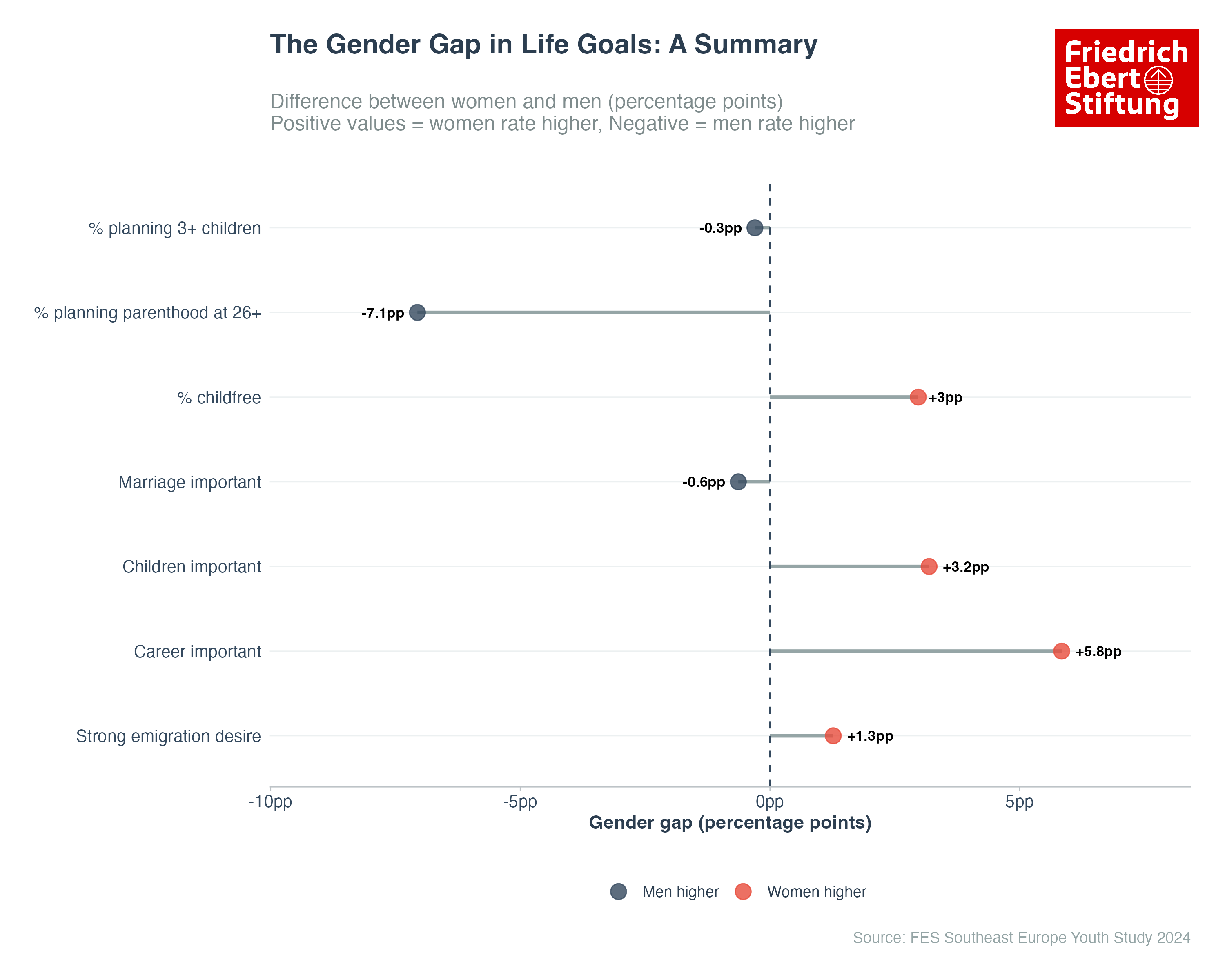
Young women are significantly more likely than men to rate career as important (+5.8 percentage points), to rate having children as important (+3.2pp), and to express strong emigration desires (+1.3pp). They are significantly less likely to plan for parenthood at age 26 or later (-7.1pp), indicating earlier expected family formation timelines.
On family size measures specifically—planning for three or more children, or planning to be childfree—the gender gaps are trivially small and not statistically significant. Marriage importance also shows no significant gender difference.
What the Data Reveals
Several key patterns emerge:
Convergence on family size: Young men and women want roughly the same number of children. The two-child family is the modal preference for both genders, and the overall difference in average planned children is statistically indistinguishable from zero. Whatever is driving fertility decisions in the region, it is not a fundamental disagreement between the sexes about family size.
Divergence on timing: Where the genders do differ is on when to have children. Young men more often envision waiting until their late twenties or later, while young women show more distributed timing preferences including substantial numbers planning for earlier parenthood. This timing mismatch could create practical challenges for relationship formation and coordination.
Women's higher ambitions across domains: Perhaps most notably, young women express higher importance ratings for nearly every life priority measured—career, education, and children alike. Rather than choosing between family and career, young women appear to want more of everything. This "having it all" orientation is significantly more common among women than men.
Country as the dominant factor: The variation in family size aspirations across countries dwarfs any gender differences. A young Slovenian man and a young Kosovar woman have far more different family expectations than a man and woman from the same country. National context—encompassing culture, economics, religion, and policy—shapes family aspirations more powerfully than gender.
Implications
These findings have several implications for understanding youth attitudes and for policy:
The fertility challenge is not a gender gap problem: Since men and women want similar numbers of children, low fertility rates in much of the region cannot be attributed to gendered disagreements about family size. The barriers to family formation lie elsewhere—in economic constraints, housing availability, work-family policies, or the gap between desired and achieved fertility for both genders.
Timing coordination may matter: The significant gender gap in preferred timing of first children could contribute to relationship challenges. If young women are ready for children earlier than their male peers, this creates potential mismatches that could delay family formation or strain partnerships. Policies and social norms around the "right time" for parenthood may need to account for these gendered differences.
Supporting women's multiple ambitions: The finding that young women want more of everything—not less of some things to have more of others—suggests that policies framed as helping women "choose" between family and career miss the mark. Young women are not asking for help choosing; they are expressing intentions to pursue multiple goals simultaneously. Policy frameworks that enable this—through childcare, flexible work, and supportive workplace cultures—align better with what young women actually say they want.
Addressing declining aspirations, not just incentivising births: The comparison with 2018 suggests that the challenge facing policymakers is broader than fertility alone. Young people are expressing lower importance for career, education, and family alike—a pattern more consistent with declining optimism than with deliberate lifestyle choices. Pronatalist policies modelled on Hungary's approach, which focus narrowly on financial incentives for childbearing, may prove insufficient if the underlying issue is that young people lack confidence in their ability to build a fulfilling life in the region at all.
Country-specific approaches: The enormous variation across countries suggests that regional generalizations about "Southeast European youth" obscure more than they reveal. A young person's family aspirations are shaped more by whether they grew up in Kosovo or Slovenia than by their gender. Policies to address demographic challenges need to account for this national specificity rather than assuming uniform regional patterns.
Conclusion
On the question of future families, young men and women across Southeast Europe largely agree on the destination but diverge on the timeline and the accompanying journey. Both genders gravitate toward the two-child family as their ideal, but men more often want to wait while women more often want to start earlier. And young women, rather than trading family for career, express higher ambitions across nearly every life domain.
This pattern of convergence on family size alongside divergence on timing and broader life priorities suggests that the gender dynamics of family formation are nuanced. The challenge for young Southeast Europeans may not be agreeing on what kind of family they want, but coordinating when and how to achieve it while pursuing the multiple other goals that—especially for young women—matter alongside parenthood.
The dominant story, however, may not be about gender at all. The gap between a young Kosovar planning for three children and a young Slovenian planning for one is far larger than any gap between young men and women within either country. For family aspirations in Southeast Europe, where you come from matters more than who you are.
About the Data
This analysis draws from the Friedrich Ebert Stiftung's Southeast Europe Youth Study 2024, examining attitudes among 8,943 young people aged 14-29 across Albania, Bosnia and Herzegovina, Bulgaria, Croatia, Kosovo, North Macedonia, Montenegro, Romania, Serbia, Slovenia, Greece, and Türkiye.
Related publication

Hasanović, Jasmin ; Lavrič, Miran ; Adilović, Emina ; Stanojević, Dragan
Youth study Southeast Europe 2024
independent but concerned: the voices of young people in Southeast Europe
See the full list of youth study publications