The Gender Gap Report — Special Issue: Bulgaria's Insecurity Fork
How Economic Precarity Pushes Young Men and Women in Opposite Directions — and Where It Does Not
Bulgaria has occupied an ambiguous position in Southeast Europe since its accession to the European Union in 2007. Economic growth has been real but uneven, and the country remains the EU's poorest member state by GDP per capita. A full accession to the Schengen area in 2025 marked a milestone of integration, but the political landscape has been defined by instability — six parliamentary elections in three years between 2021 and 2024. Against this backdrop, young Bulgarians are forming their views about democracy, rights, and who belongs in the political community. The Friedrich Ebert Stiftung's 2024 Youth Study surveyed 750 young Bulgarians aged 14–29 and asked them about everything from the rights of minorities to the merits of dictatorship. Their answers reveal a gender divide that is large, selective, and — most importantly — influenced by how secure young people feel about their economic lives.
This special issue of The Gender Gap Report examines the interaction between gender and economic insecurity in Bulgaria: how the gap between young men's and young women's attitudes shifts depending on whether they feel financially comfortable or precarious, and whether they expect their lives to get better or worse. The hypothesis under examination is straightforward: economic insecurity amplifies the gender gap in political attitudes. The reality that emerges from the data is more complicated.
The Baseline: Where Bulgarian Men and Women Diverge
Before examining how economic insecurity interacts with gender, it is worth establishing where the gender gap already stands. The survey includes twelve attitude measures that can we grouped into two clusters: exclusionary and authoritarian attitudes (where previous research leads us to expect men to score higher) and solidaristic and pro-democracy attitudes (where we expect women to score higher). The results across all twelve items confirm the expected direction but with wide variation in magnitude and statistical reliability.
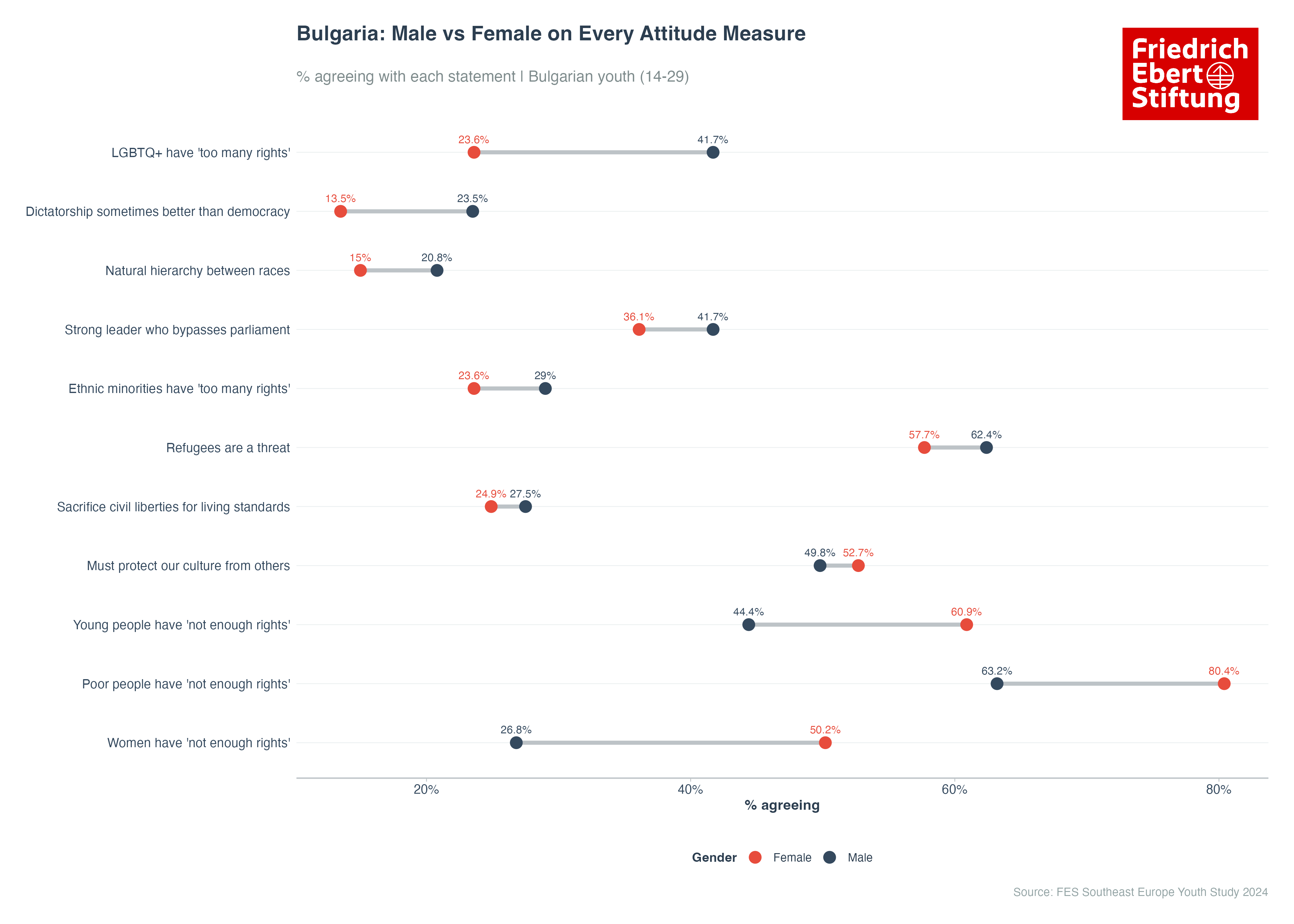
On the exclusionary side, the largest and most statistically significant gender gap is on LGBTQ+ rights: 41.7% of young Bulgarian men say LGBTQ+ people have "too many rights," compared to 23.6% of young women — an 18.1 percentage point gap that is highly significant (p < 0.001). This mirrors the regional pattern documented in Part 9 of this series, where LGBTQ+ attitudes consistently produce the sharpest gender divides. Support for dictatorship as "sometimes better" also shows a significant gap: 23.5% of young men versus 13.5% of young women agree, a 10 percentage point difference (p < 0.01).
But beyond these two items, the exclusionary gender gap weakens considerably. On the remaining six measures — ethnic minorities having "too many rights," belief in a natural racial hierarchy, support for a strong leader bypassing parliament, willingness to sacrifice civil liberties, cultural protectionism, and viewing refugees as a threat — the gaps range from 2.6 to 5.8 percentage points and none reach statistical significance. For example, 62.4% of young men and 57.7% of young women view refugees as a threat — a near-consensus that crosses gender lines. And on protecting culture from outside influences, young women actually score marginally higher than young men (52.7% versus 49.8%), though the difference is again not significant.
On the solidaristic side, the picture is sharper. Young women are far more likely to perceive rights deficits for disadvantaged groups: 50.2% say women do not have enough rights compared to 26.8% of men (a 23.4 point gap); 80.4% say the poor lack rights versus 63.2% of men (17.2 points); and 60.9% say young people lack rights versus 44.4% of men (16.6 points). All three gaps are highly significant (p < 0.001).
One finding cuts against the pattern. On whether democracy is always preferable to other forms of government, young men are actually 10.6 percentage points more likely to agree than young women (40.3% versus 29.6%, p < 0.01). This is the only item where men take the more "solidaristic" or liberal-democratic position. It is a finding that complicates any simple narrative of young women as uniformly more progressive, and suggests that Bulgarian women's greater sensitivity to rights deficits does not automatically translate into stronger attachment to democratic governance as a principle.
The Insecurity Fork: Testing the Mechanism
The core hypothesis of this analysis is that economic insecurity does not merely make people more or less authoritarian; it pushes men and women in opposite directions. The metaphor is a fork: under economic pressure, men's attitudes tilt toward exclusion and authoritarianism while women's tilt toward solidarity and rights expansion. If this is correct, the gender gap should be wider among economically precarious youth than among comfortable ones.
The survey provides a direct measure of economic circumstances: respondents were asked to rate their household's financial situation on a five-point scale from "we cannot make ends meet" to "we can save a lot." Collapsing this into three categories — precarious (bottom two), in between, and comfortable (top two) — produces a clear economic gradient. In Bulgaria, 22% of the sample falls into the precarious category, 22% in between, and 56% comfortable.
When the exclusionary and solidaristic attitude indices are plotted by gender across these three economic categories, a pattern emerges, but not necessarily the one the hypothesis predicted.
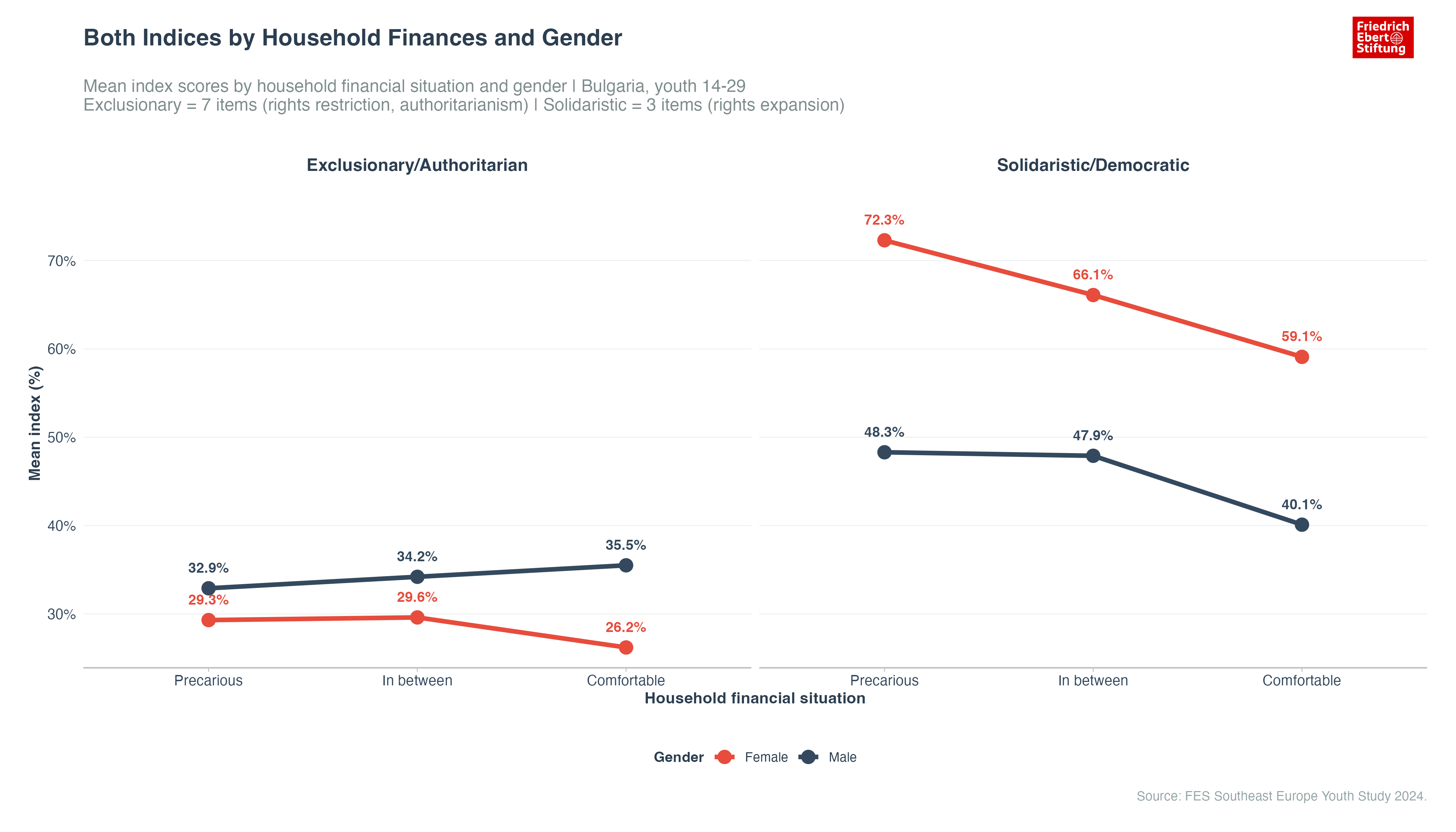
On the exclusionary index, the gender gap appears descriptively smallest among precarious youth (32.9% for men versus 29.3% for women, a gap of 3.6 points) and largest among comfortable youth (35.5% versus 26.2%, a gap of 9.3 points). On the solidaristic index, the gender gap is large across all three economic categories: women outscore men by 24 points among the precarious, 18.2 points in between, and 19 points among the comfortable.
However, the statistical tests do not confirm either pattern as reliable. The interaction between gender and precarity on the exclusionary index is not statistically significant (p = 0.16), and the same is true for the solidaristic index (p = 0.75). What is significant, and strongly so, is the gender main effect: being female is associated with a 9.3 percentage point lower exclusionary index score (p < 0.001), regardless of economic circumstances. In other words, gender is a powerful and consistent predictor of attitudes in Bulgaria. Economic insecurity is not, at least not when it comes to amplifying the gender divide.
Pessimism and Optimism: A Similar Story
A second measure of subjective insecurity — how respondents expect their personal situation to be in ten years — offers another angle on the same question. Most Bulgarian youth are optimistic: 77% expect things to get better, 14% expect them to stay the same, and just 8% expect them to get worse.
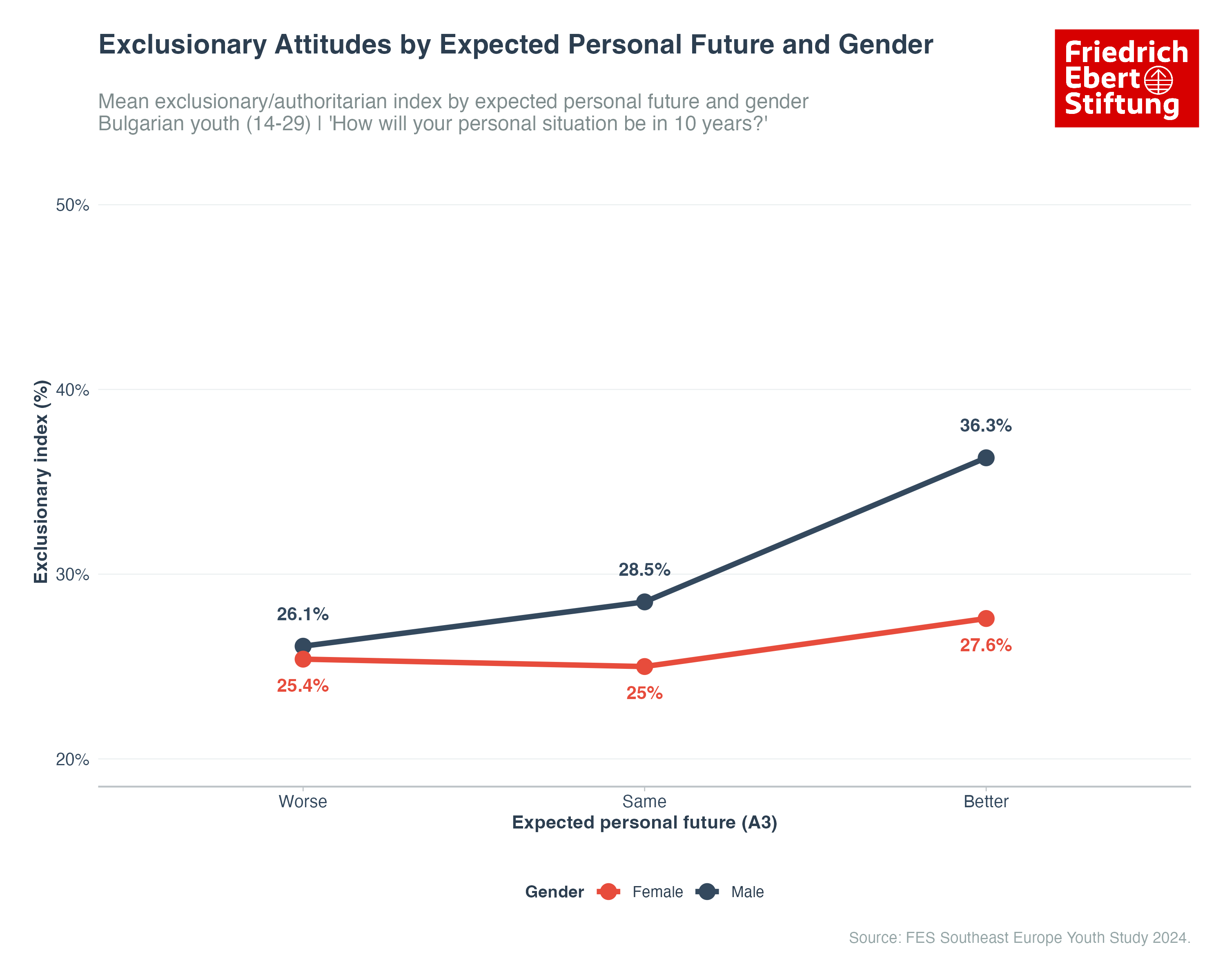
Among the small group of pessimists, those who expect things to get worse, the gender gap on the exclusionary index is negligible: pessimistic men score 26.1% and pessimistic women score 25.4%. Among optimists, the gap widens to 8.7 points (36.3% for men versus 27.6% for women). However, the interaction term is not statistically significant (p = 0.31), and with only 57 pessimists in the sample, the estimates for this subgroup are too noisy to support firm conclusions. The descriptive pattern is consistent with the household finances finding: there is no evidence that insecurity is the mechanism that widens the gender gap in exclusionary attitudes. If anything, the data suggests the opposite, that the widest gaps appear among young men and women who feel economically secure and optimistic about the future.
Bulgaria in Regional Context
How does Bulgaria's gender gap compare to the rest of Southeast Europe? Across the twelve countries in the Youth Study, the exclusionary index gender gap, measured as the difference between male and female mean scores, varies from 12.1 percentage points in Slovenia to essentially zero in Turkey.
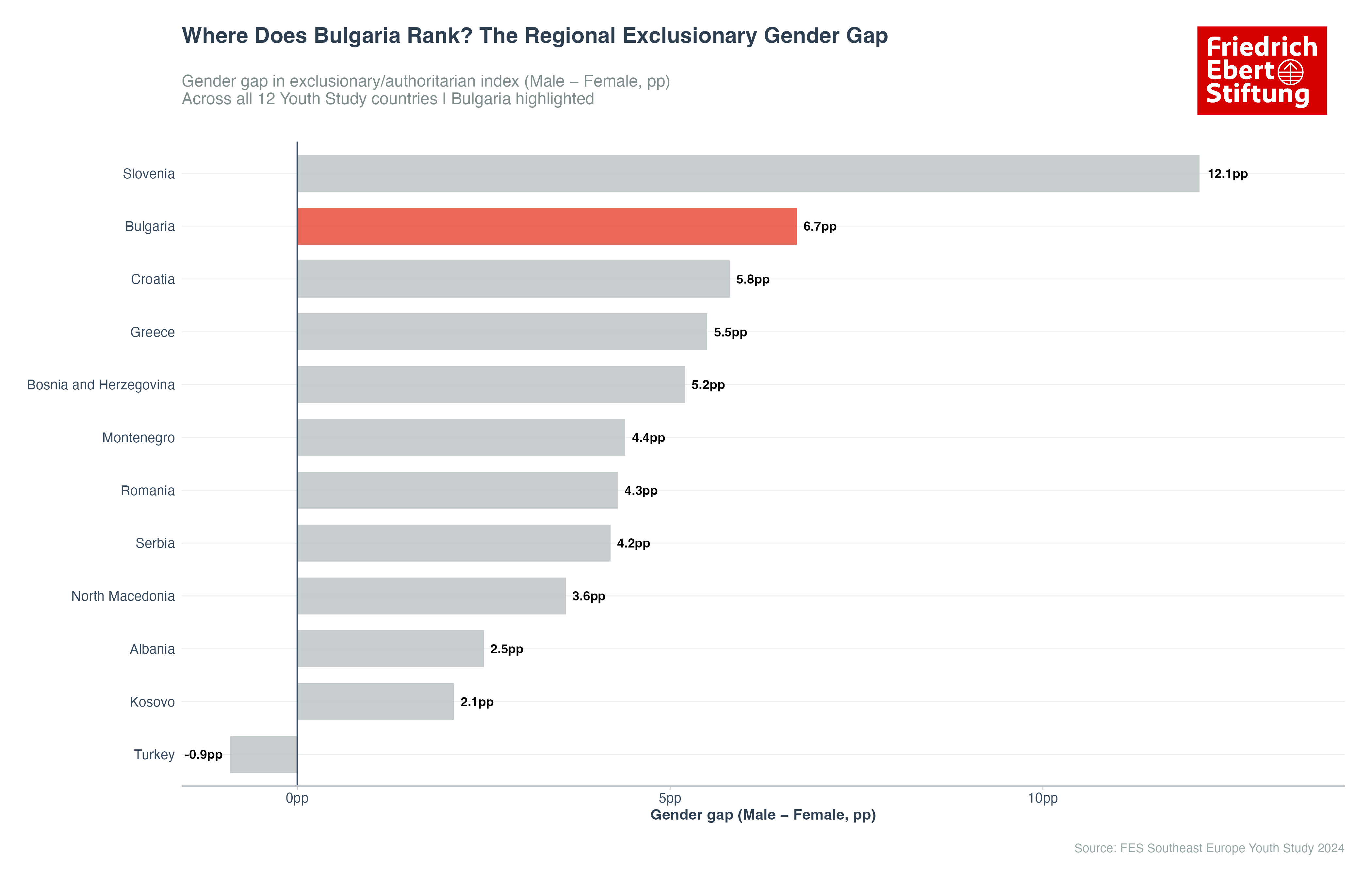
Bulgaria ranks second, with a 6.7 percentage point gap — smaller than Slovenia's but larger than any other country in the sample. This is a highly significant gap (p < 0.001) and confirms that gender is a meaningful predictor of exclusionary attitudes among Bulgarian youth by regional standards.
The regional data also sheds light on the insecurity fork hypothesis more broadly. When the gender-by-precarity interaction is tested across all twelve countries combined, the interaction is statistically significant (p = 0.002): across the region as a whole, economic precarity does appear to amplify the gender gap in exclusionary attitudes. But the effect is not uniform. Country-by-country tests reveal significant interactions only in Albania (p = 0.01) and Romania (p = 0.02). In the remaining ten countries. Bulgaria included, the interaction does not reach significance individually. This is largely a matter of statistical power: with country samples ranging from 500 to 1,230 respondents, split by gender and three financial categories, cell sizes shrink rapidly, and an interaction term — which estimates a difference of differences — is inherently difficult to detect. SOne country that shows a substantively similar effect that falls short of significance is Bosnia and Herzegovina (p = 0.075).
What the Data Reveals
Bulgaria's data tells a story with several layers, some expected and some not.
A selective but significant gender gap. Young Bulgarian men and women diverge on some measures — LGBTQ+ rights, support for dictatorship, women's rights perceptions — but not on others, including cultural protectionism, refugee attitudes, and racial hierarchy. The gender gap is concentrated on specific items rather than spread evenly across all attitudes. Where it does exists, it is among the largest in the region.
The insecurity fork does not hold in Bulgaria. The hypothesis that economic precarity amplifies the gender gap finds no statistical support in the Bulgarian data. The gender-by-precarity interaction is not significant on either the exclusionary or solidaristic index. Whatever is driving the gender gap in Bulgaria, it is not the experience of economic hardship pulling men and women in opposite directions.
Women's democracy skepticism is notable. The finding that young Bulgarian women are significantly less likely than men to say democracy is always preferable to other forms of government (29.6% versus 40.3%) deserves attention. Combined with women's greater sensitivity to rights deficits, one could interpret this as a population that sees the failures of the current system more acutely than young men and may be less willing to endorse that system in the abstract as a result. Whether this reflects principled skepticism or disillusionment would require further investigation.
The regional fork exists, but Bulgaria is not where it bites. Across the twelve-country sample, economic precarity does significantly amplify the gender gap in exclusionary attitudes. But this is driven by specific countries — particularly Albania and Romania — rather than by a uniform effect everywhere. Bulgaria is part of the majority of countries where the interaction is present in the aggregate data but does not reach significance individually.
Implications
Economic interventions alone will not close the gender gap. If the insecurity fork held in Bulgaria — if economic hardship were the mechanism driving men toward exclusionary attitudes and women toward solidarity — then improving material conditions would be a plausible route to narrowing the attitudinal divide. The data does not support this. The gender gap in Bulgaria operates independently of economic circumstances. Interventions aimed at reducing the gender divide in attitudes will need to address culture, identity, and social norms, not just material security.
The LGBTQ+ divide is Bulgaria's deepest fissure. As in most countries examined in this series, LGBTQ+ attitudes produce the widest and most statistically robust gender gap. Nearly twice as many young Bulgarian men as women say LGBTQ+ people have "too many rights." This 18.1 percentage point gap dwarfs all other divides and is consistent with findings from Part 9 of this series, where LGBTQ+ attitudes were the single most gender-polarizing domain across the entire region.
The refugee consensus is striking. Six in ten young Bulgarians of both genders view refugees as a threat; one of the highest rates in the sample and one with essentially no gender gap. This is a domain where the gender divide that structures other attitudes simply does not operate. For organizations working on refugee issues in Bulgaria, the challenge is not gendered polarization but broad-based skepticism.
Women's democratic skepticism warrants attention. The finding that young Bulgarian women are less likely than men to affirm democracy as always preferable is unusual in the regional context. It does not mean young women are more authoritarian — their scores on dictatorship and strong-leader items are lower than men's. But it may signal that young women, who perceive more rights deficits and more social problems, are also more aware of democracy's failures to deliver on its promises. Engagement strategies that treat democratic commitment as a given among young women may miss this undercurrent of skepticism.
Conclusion
Bulgaria's gender gap in political attitudes is real, large by regional standards, and highly selective. It is concentrated on LGBTQ+ rights and authoritarian governance rather than spread across all domains. Young women see more rights deficits, express more solidarity with disadvantaged groups, but are also less convinced that democracy is always the answer. Young men are more exclusionary and more authoritarian on specific measures, but share women's views on refugees, racial hierarchy, and cultural protectionism.
The most important finding may be a negative one. The insecurity fork — the hypothesis that economic precarity amplifies these gender differences — does not hold in Bulgaria. The gender gap does not widen under economic pressure.
However, the insecurity fork is a real phenomenon in the region, confirmed by significant interaction effects in the pooled twelve-country data. But it is not universal. In Bulgaria, the gender gap stands on its own — independent of household finances, independent of personal outlook, and driven by the specific domains of sexuality, governance, and group rights where young men and women across Southeast Europe most consistently part ways.
About the Data
This analysis draws from the Friedrich Ebert Stiftung's Southeast Europe Youth Study 2024, examining attitudes among 750 young people aged 14–29 in Bulgaria, with comparisons to the full twelve-country sample of 8,943 respondents across Albania, Bosnia and Herzegovina, Bulgaria, Croatia, Kosovo, North Macedonia, Montenegro, Romania, Serbia, Slovenia, Greece, and Turkiye. The exclusionary/authoritarian index is a composite of seven binary indicators (LGBTQ+ and ethnic minority "too many rights," cultural protectionism, racial hierarchy, dictatorship support, strong leader support, and willingness to sacrifice civil liberties). The solidaristic index is a composite of four binary indicators (women, poor people, and young people having "not enough rights," and democracy as always preferable).
Youth Study Southeast Europe

Hasanović, Jasmin ; Lavrič, Miran ; Adilović, Emina ; Stanojević, Dragan
Youth study Southeast Europe 2024
independent but concerned: the voices of young people in Southeast Europe
Youth Study Bulgaria

Popivanov, Boris ; Simeonov, Parvan ; Georgiev, Stefan ; Elenkova, Liliya ; Petkova, Yanitsa ; Galyova, Yuliana
Youth study Bulgaria 2024
optimism for the self, pessimism for society: Bulgaria's youth facing times of insecurity
Contact
See the full list of youth study publications