The Gender Gap Report — Special Issue: Romania's Rights Hierarchy
Who Deserves More Rights — and Where Gender Reshapes the Answer
Romania occupies an unusual position in Southeast Europe's political landscape. A member of the European Union since 2007, the country has undergone rapid economic transformation while its social attitudes have shifted unevenly. In 2018, a referendum to constitutionally define marriage as between a man and a woman failed due to low turnout, widely interpreted as a sign that most Romanians simply did not care enough about the issue to vote — rather than evidence of liberal sympathy. More recently, the country's 2025 presidential election saw a far-right candidate reach the final round, reflecting currents of nationalist and socially conservative sentiment among sections of the electorate. These crosscurrents — between EU integration and traditionalist backlash, between generational change and institutional inertia — make Romania a particularly interesting case for examining how young people think about rights and equality.
The Friedrich Ebert Stiftung's 2024 Youth Study asked 1,145 young Romanians aged 14–29 a simple question about five different groups: do they have not enough rights, enough rights, or too many rights in your country? The groups were women, ethnic minorities, LGBTQ+ people, poor people, and young people. Their answers reveal not just who young Romanians think is getting a fair deal, but also where gender creates a chasm in perception — and, crucially, where it does not.
This special issue of The Gender Gap Report examines Romania's rights hierarchy in detail, using a combination of rights perception data and corroborating attitude measures to build a picture of how young men and women in Romania see the social order and where they disagree about whether it needs to change.
The Rights Hierarchy: Who Gets Sympathy?
When both genders are combined, a clear hierarchy emerges in who young Romanians see as lacking rights. Poor people top the list by a wide margin: two-thirds (66%) say they do not have enough rights. Young people come second at 55%. Women (42%), LGBTQ+ people (38%), and ethnic minorities (35%) follow in descending order.
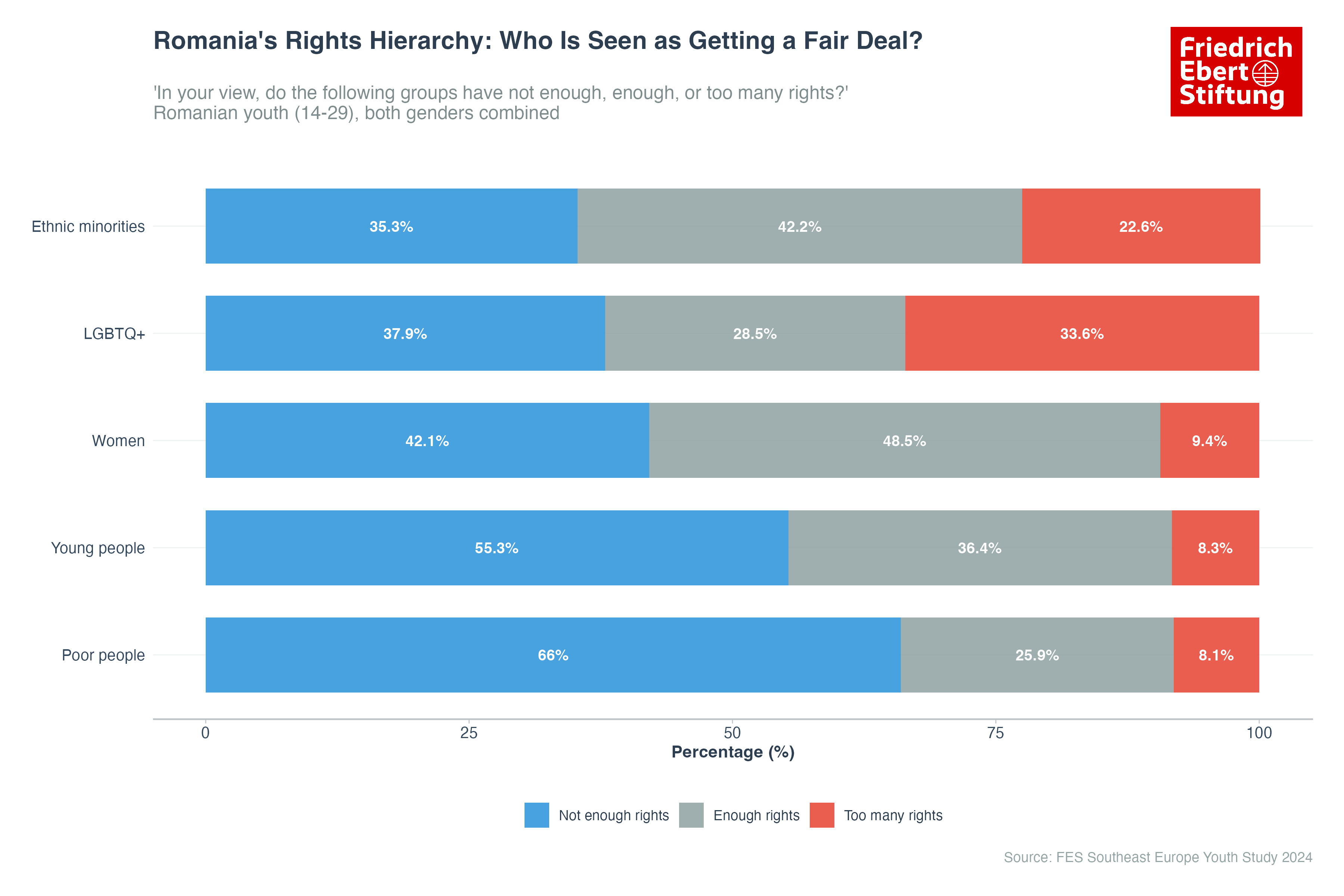
But the overall numbers conceal a critical detail. The "not enough rights" and "too many rights" responses tell different stories depending on the group. For poor people and young people, there is broad consensus: large majorities see rights deficits and very few — around 8% — think these groups have too many rights. These are sympathetic categories that cut across gender lines.
LGBTQ+ people, by contrast, are the most polarizing group in the survey. Nearly as many young Romanians say LGBTQ+ people have too many rights (34%) as say they have not enough (38%). No other group comes close to this level of division. Ethnic minorities occupy a middle ground, with roughly one in four (23%) young Romanians saying they have too many rights; less polarizing than LGBTQ+ but substantially more contested than poverty or youth.
This hierarchy — economic sympathy at the top, sexual identity and ethnicity contested at the bottom — sets the stage for the gender analysis that follows. Because it is precisely on the contested groups where the gender gap matters most.
The Gender Gap: Large, Universal, but Not Uniform
Young Romanian women are more likely than young men to say every group lacks sufficient rights. The gender gap is statistically significant across all five groups. But its size varies dramatically — and that variation is the story.
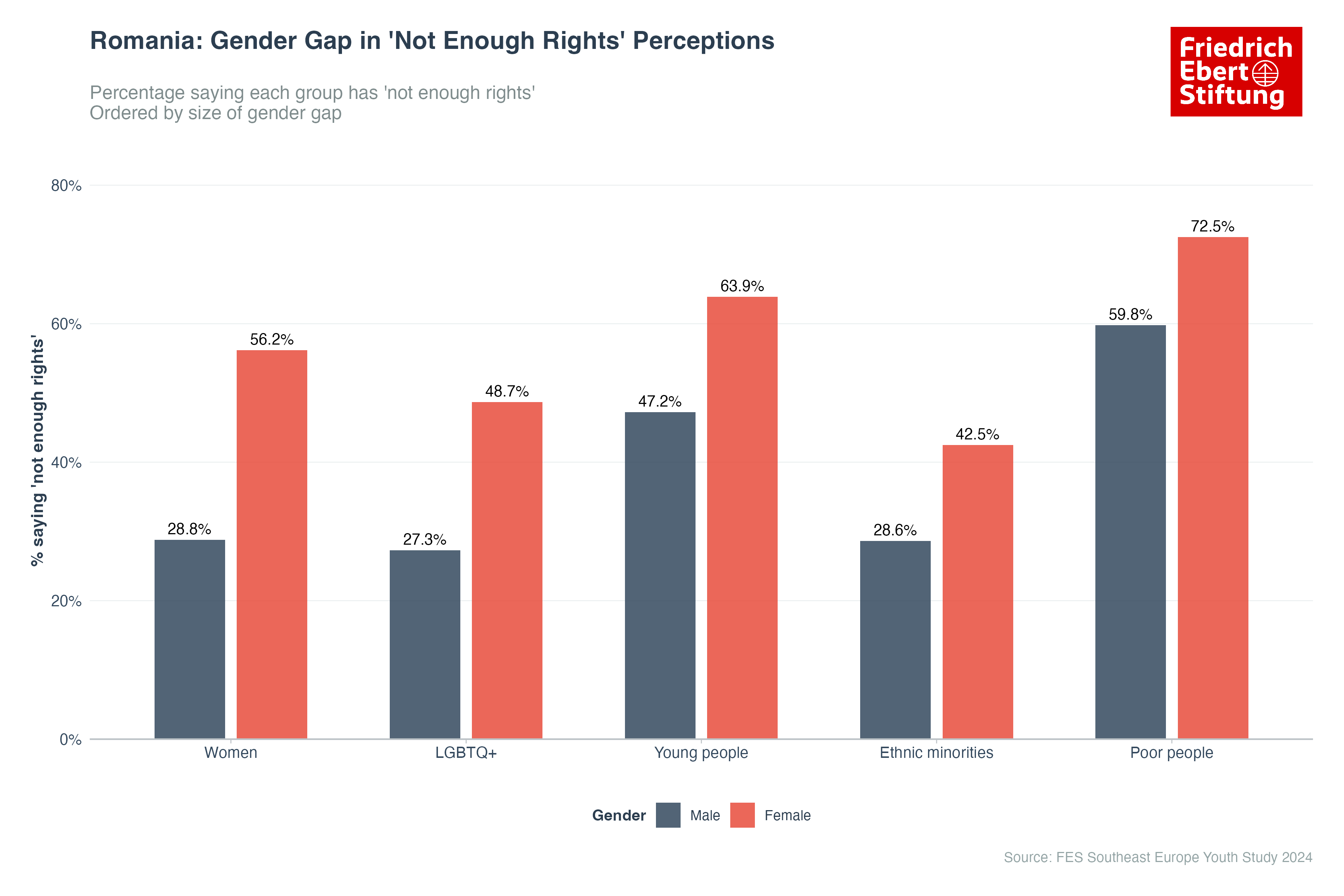
The largest gap is on women's rights themselves: 56% of young women say women do not have enough rights, compared to 29% of young men — a 27 percentage point chasm. This mirrors the finding from Part 6 of this series, which documented a similar perception divide across the region. Romania's gap of 27 points ranks second-largest of all twelve countries, behind only Bosnia and Herzegovina.
The second-largest gap is on LGBTQ+ rights: 49% of young women versus 27% of young men see rights deficits — a 21-point gap. Then comes young people's rights (16.7 points), ethnic minority rights (13.9 points), and poor people's rights (12.6 points).
The pattern is clear: the more a rights question touches on identity and social hierarchy — gender, sexuality, ethnicity — the larger the gap between young men and women. The more it touches on economic or generational disadvantage — poverty, youth — the gap narrows, though it does not disappear.
The Other Side: Who Has "Too Many" Rights?
The "too many rights" responses reveal an equally important dimension. Here, young men are consistently more likely than young women to perceive rights overreach, but the gap is overwhelmingly concentrated on one group.
LGBTQ+ people stand out: 43% of young Romanian men say LGBTQ+ people have too many rights, compared to 24% of young women — an 18-point gap that is the largest "too many rights" gender divide in the data, and highly statistically significant. For women's rights, 13% of young men versus 6% of young women see overreach — significant but far smaller. For ethnic minorities, the gap is 6 points. For poor people and young people, the gender gap in "too many rights" perceptions is negligible and not statistically significant.
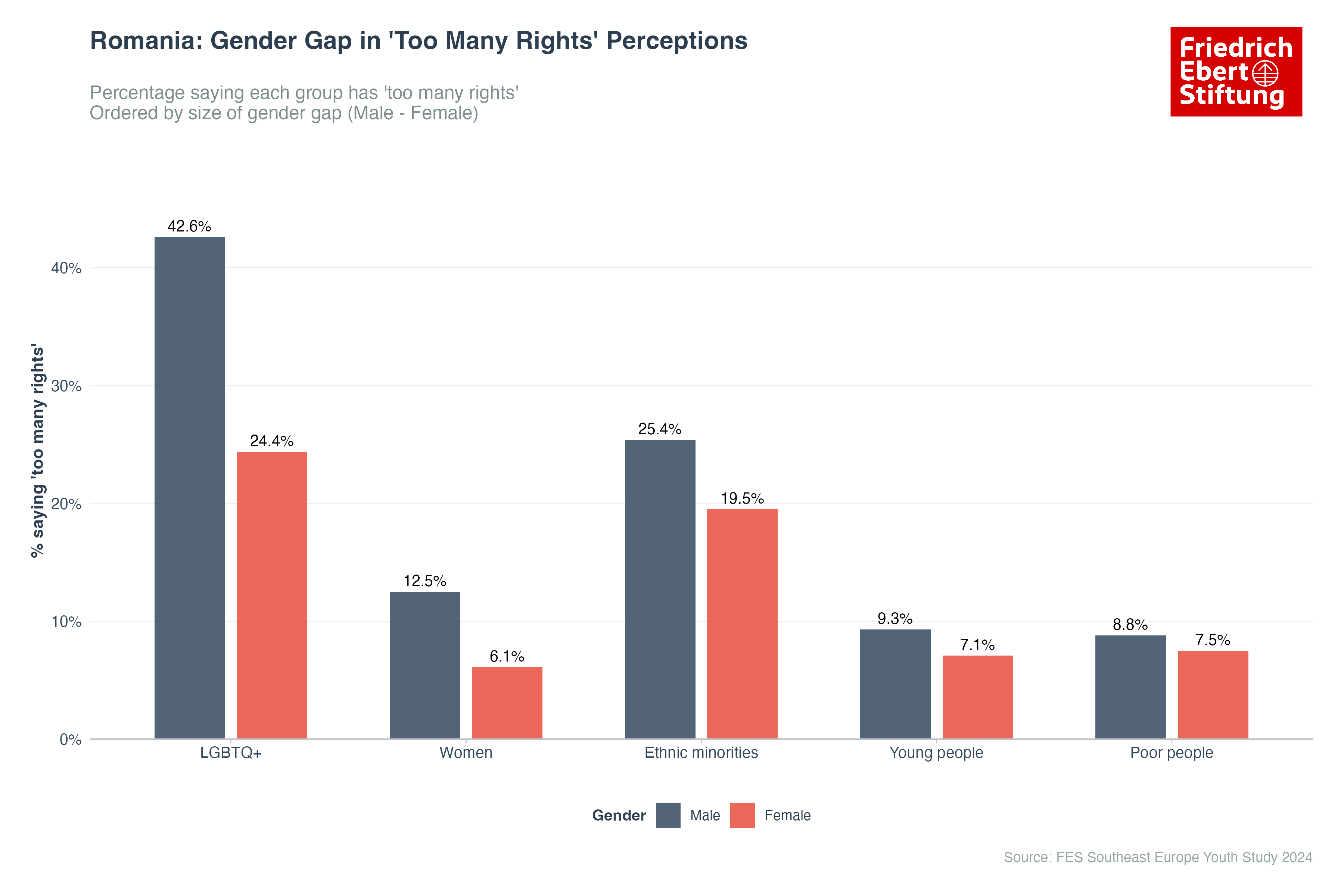
What this means in practice is important. Nearly half of young Romanian men — a plurality — believe LGBTQ+ people already have too many rights. This is not a fringe position; it is the single most common response among young men on this question, surpassing both "not enough rights" (27%) and "enough rights" (30%). Among young women, by contrast, the most common response is "not enough rights" (49%). On no other group do young men and women select different modal categories.
Where Attitudes Corroborate — and Where They Don't
The gender gap in rights perceptions is broad — women see more deficits for all five groups. But is this because young women hold different attitudes from young men across the board, or is something more specific going on? The survey included a separate battery of attitude statements that allow us to probe what lies beneath the perception gaps. The answer turns out to be more nuanced than the rights data alone would suggest.
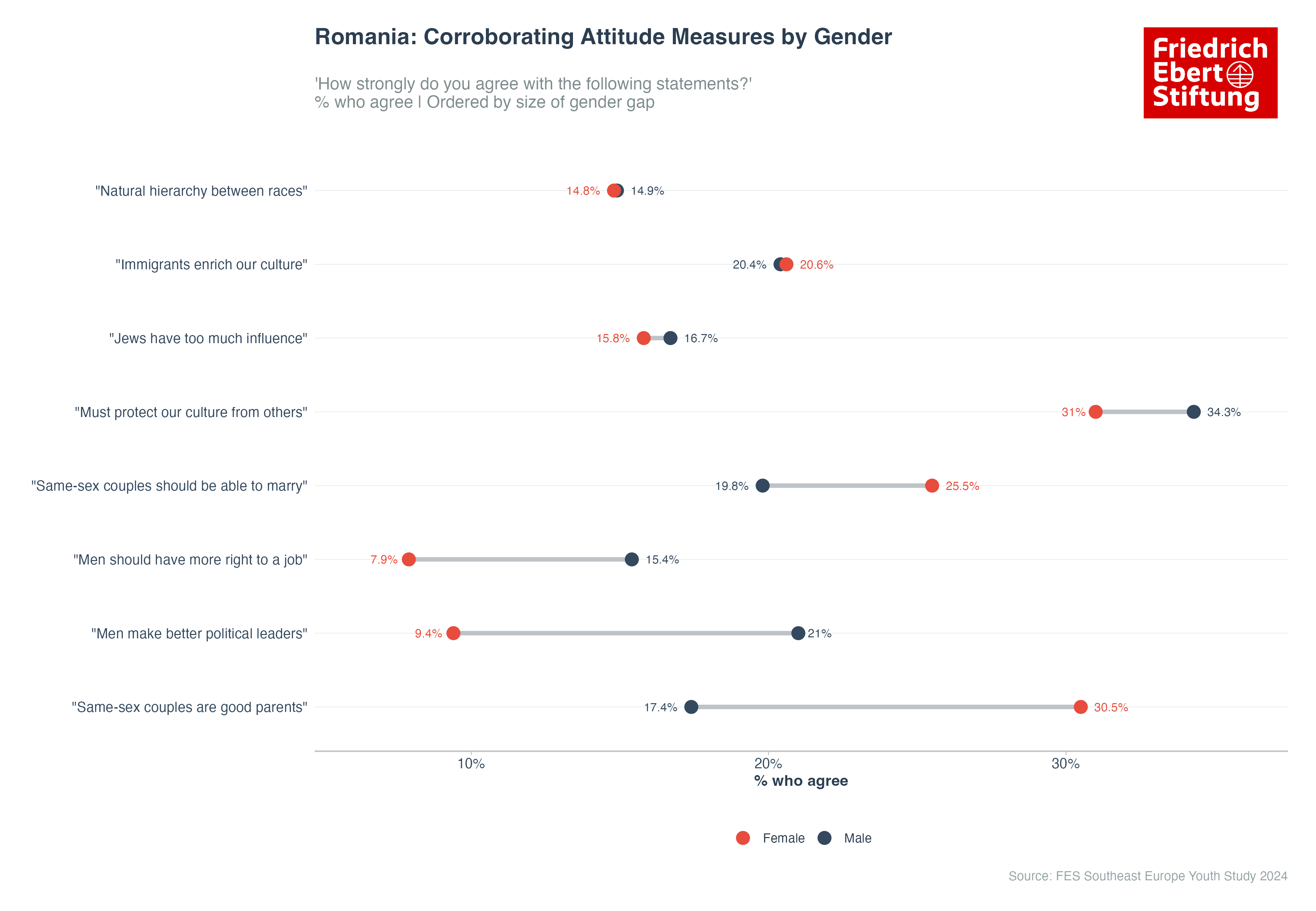
On gender-related attitudes, the rights perception gap is matched by clear attitudinal differences. Twenty-one percent of young men agree that men make better political leaders, compared to 9% of young women — a gap of nearly 12 points. Fifteen percent of young men agree that men should have more right to a job when jobs are scarce, versus 8% of young women — a 7.5-point gap. Both differences are highly statistically significant. Young women perceive women as lacking rights, and they hold less sexist views — the perception and the attitude align.
On LGBTQ+-related attitudes, the same pattern holds. Thirty-one percent of young women agree that same-sex couples are as good parents as other couples, compared to 17% of young men — a 13-point gap, the largest on any item in this battery. Twenty-six percent of young women support same-sex marriage rights versus 20% of young men. Again, perception and attitude corroborate each other.
But on ethnic and racial prejudice measures, something different happens. The gender gap in rights perceptions — where women are 14 points more likely to see ethnic minorities as lacking rights — is not matched by any corresponding difference in underlying attitudes. Fifteen percent of both young men and young women agree that there is a natural hierarchy between races. Seventeen percent of young men and 16% of young women agree that Jews have too much influence. Around 20% of both genders agree that immigrants enrich Romanian culture. None of these differences are statistically significant.
This disconnect is revealing. On gender and sexuality, young women both perceive more rights deficits and hold less prejudiced views — the gap runs all the way down. On ethnicity and race, young women perceive more rights deficits but are no less prejudiced than young men. This suggests that the gender gap in rights perceptions has two distinct sources: on gender and sexuality, it is driven by genuinely different attitudes; on other groups, it may reflect a broader sensitivity to inequality among young women — a general rights consciousness that extends even to domains where their own views are no more progressive than men's.
Romania in Regional Context
How does Romania's gender gap in rights perceptions compare to the rest of Southeast Europe? Across the twelve countries surveyed, Romania consistently ranks among the countries with the largest gender divides.
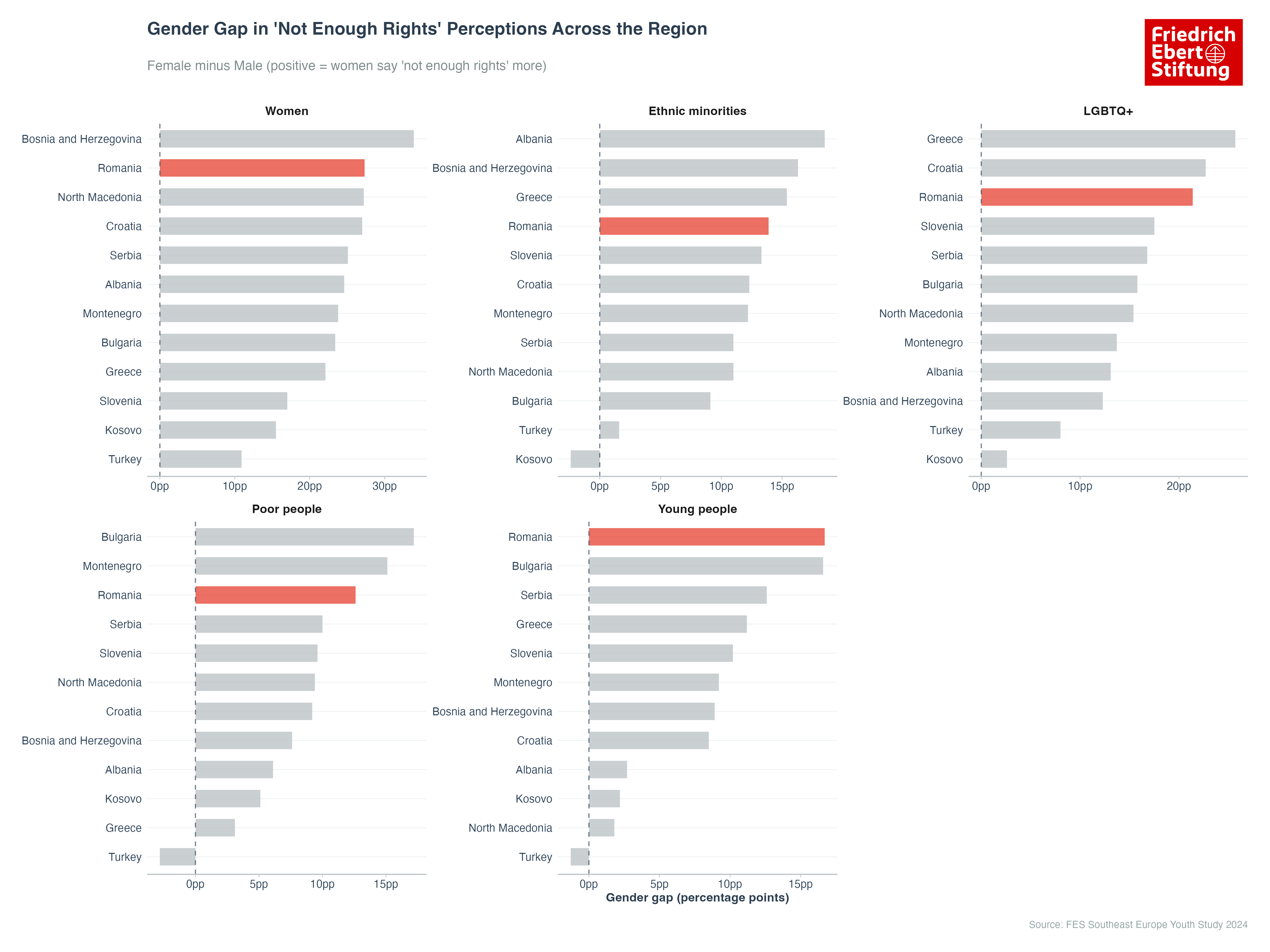
On women's rights, Romania's 27-point gender gap ranks second of twelve countries, only behind Bosnia and Herzegovina (34 points). On LGBTQ+ rights, Romania ranks third (21 points), behind Greece and Croatia. On young people's rights, Romania has the single largest gender gap in the entire region at nearly 17 points, larger than any other country. On poor people's rights and ethnic minority rights, Romania also ranks in the top tier.
This consistent placement near the top of the regional rankings is notable. Romania is not an outlier on any single dimension, but it is among the most gender-divided countries across all five groups. As we have just seen, the underlying sources of that broad gap differ by domain — rooted in genuinely different attitudes on gender and sexuality, but in a more diffuse rights consciousness on poverty, youth, and ethnicity. Either way, the result is the same: young Romanian women and men look at their society and see different levels of fairness, across more domains than in most of their regional peers.
Political Orientation: Where the Gap Explodes — and Collapses
Breaking down rights perceptions by political orientation within Romania reveals one of the most dramatic patterns in the data. The gender gap is not uniform across the political spectrum, it interacts with ideology in ways that differ strikingly by group.
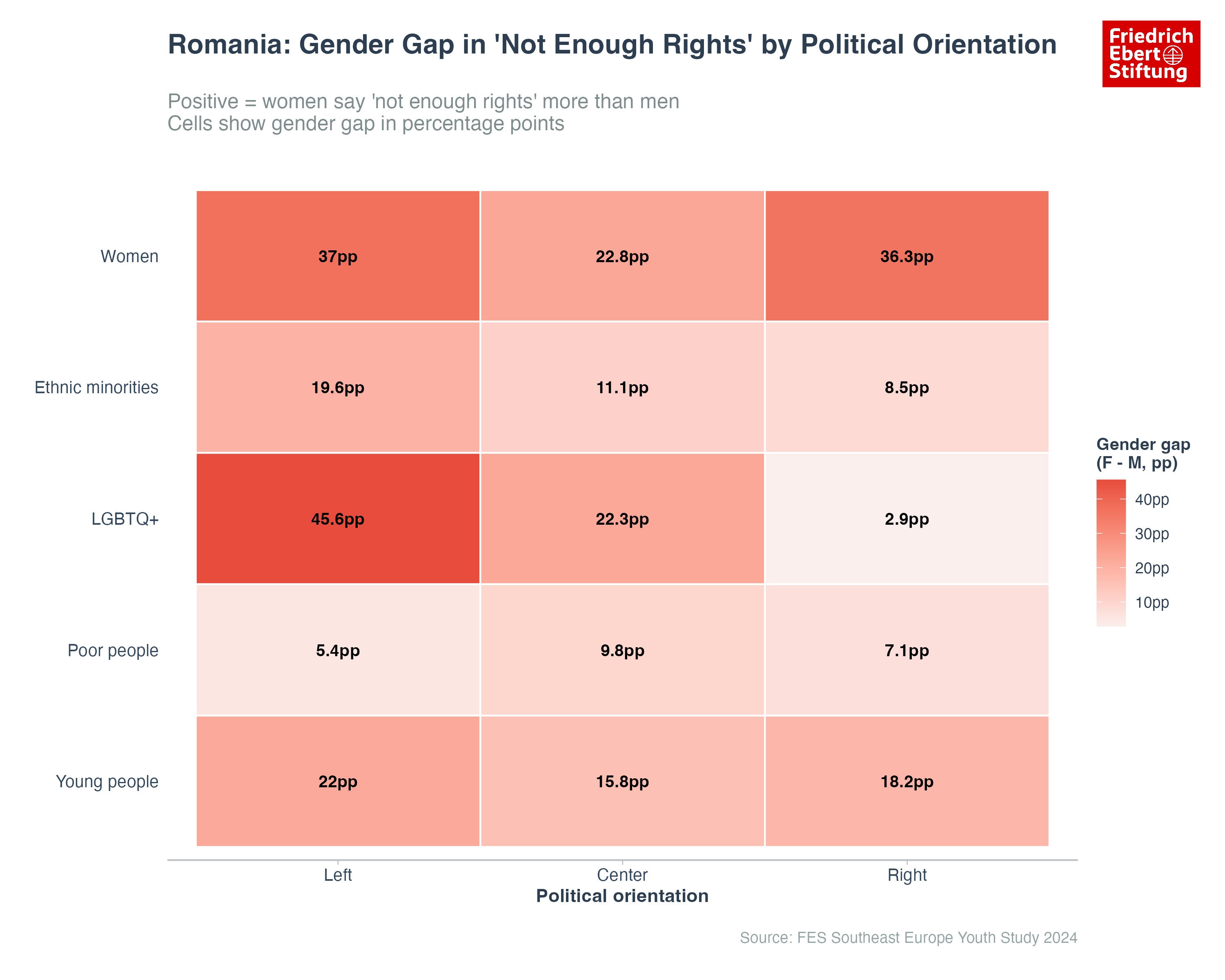
On LGBTQ+ rights, the interaction is extraordinary. Among left-wing youth, 72% of women say LGBTQ+ people lack sufficient rights — compared to just 26% of men. That is a gender gap of 46 percentage points, among the largest on any single measure in this entire series. Among centrists, the gap narrows to 22 points. And among right-wing youth, it nearly disappears: 29% of women versus 26% of men — a gap of just 3 points.
The mechanism here is asymmetric. Left-wing men and right-wing men hold virtually identical views on LGBTQ+ rights (26% versus 26% saying "not enough"). It is women whose views shift dramatically across the political spectrum: from 72% on the left to 29% on the right. Left-wing political identification is associated with far greater LGBTQ+ rights consciousness among women, but not among men — echoing the finding from Part 9 of this series on LGBTQ+ acceptance more broadly.
On women's rights, a different pattern appears. The gender gap is large across the entire political spectrum — 37 points on the left, 23 in the center, 36 on the right. Here, political orientation does not substantially moderate the gender divide. Young men of all political stripes are roughly equally unlikely to see women's rights deficits; young women of all stripes are roughly equally likely to see them.
For poor people, the gender gap is modest across all political orientations (5–10 points), and right-wing youth of both genders show lower concern — suggesting that economic rights perceptions follow a more conventional left-right pattern with relatively little gender differentiation.
The backlash data reinforces this picture. Among left-wing young men, 46% say LGBTQ+ people have too many rights — virtually identical to 48% of right-wing young men. Among left-wing women, the figure is just 17%. Political progressivism among Romanian men does not translate into lower LGBTQ+ backlash. At all.
Education: Widening the Gap, Not Closing It
One might expect education to narrow the gender gap — and on some measures across the region, it does. But on LGBTQ+ rights in Romania, the opposite happens. Among young people aged 19–29 with low education, the gender gap in "not enough rights" perceptions is 15 percentage points (60% of women vs 46% of men). Among those with high education, the gap widens to 32 points (56% of women vs 24% of men).
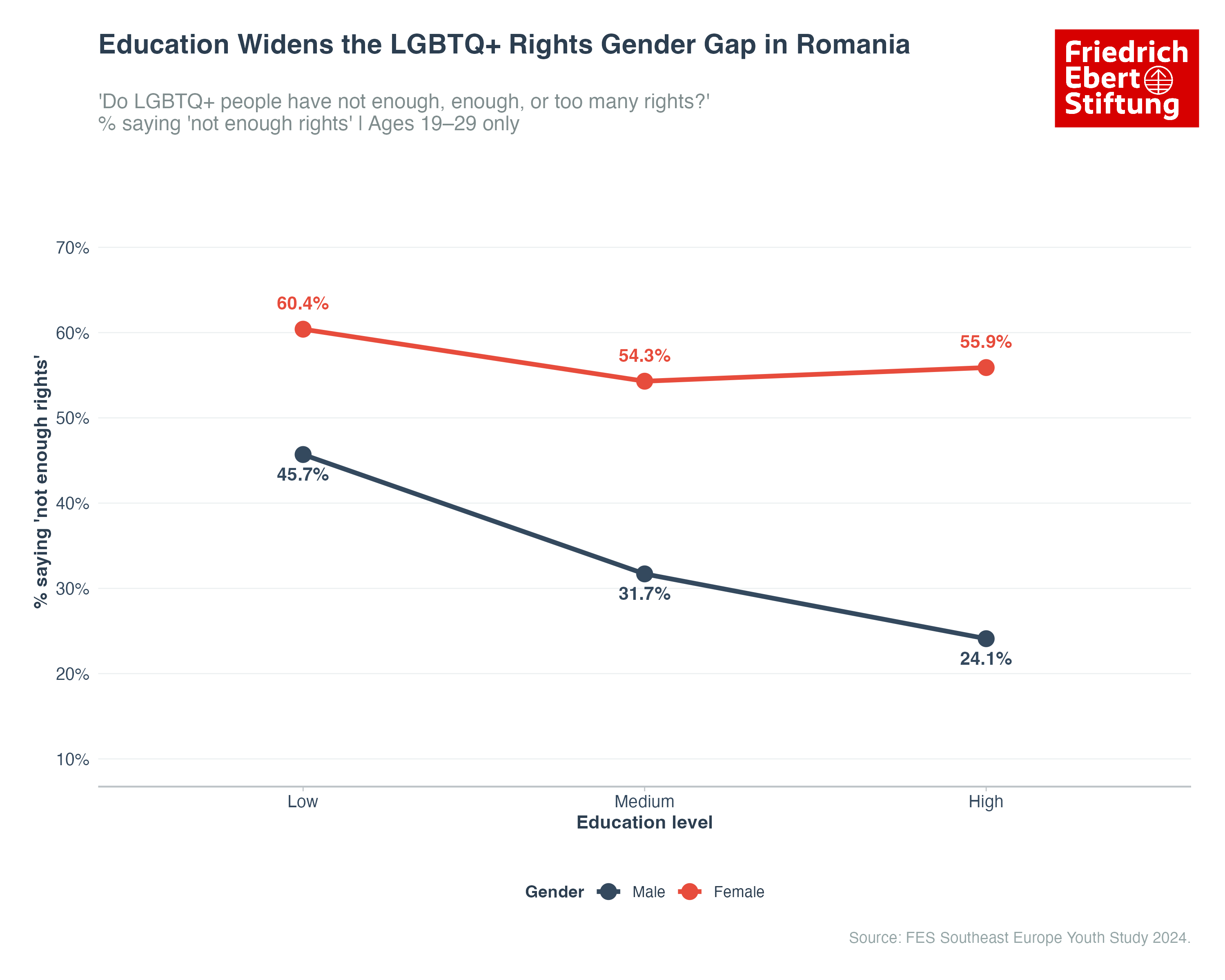
The mechanism is asymmetric. Women's LGBTQ+ rights perceptions barely shift with education level — roughly 56–60% see rights deficits regardless. Men's perceptions, however, drop sharply: from 46% among the least educated to 24% among the most. Highly educated young Romanian men are less likely to perceive LGBTQ+ rights deficits than their less educated peers, while women's perceptions remain stable. The result is that, in this case, education surprisingly amplifies the gender gap rather than closing it.
The Multivariate Picture
Statistical models controlling for gender, political orientation, education, urban-rural location, and age confirm that gender is the dominant individual-level predictor of rights perceptions in Romania. Being female is by far the strongest and most significant predictor of believing women do not have enough rights — more powerful than any other variable in the model. For LGBTQ+ "too many rights" perceptions, gender is again the strongest predictor, with being female significantly reducing the probability of holding this view, even after accounting for political orientation and education. Right-wing orientation and higher education both show associations with higher LGBTQ+ backlash, but neither reaches the magnitude or significance level of gender.
Notably, urban-rural location and age group do not significantly predict rights perceptions in Romania once other factors are controlled for. The gender gap is not a proxy for city dwellers being more progressive or older youth having different views — it operates independently of these demographic factors. The cross-tabulations confirm this: the gender gap in women's rights perceptions, for instance, is 37 points in rural areas and 22 points in urban areas — large and significant in both settings. Similarly, the gap persists across education levels, reaching 28 points even among the most highly educated 19–29 year olds. As in previous installments of this series, the gender divide proves remarkably resistant to the usual demographic explanations.
What the Data Reveals
Romania's rights perception data tells a story with several distinct layers:
A selective gender gap. Young Romanian men and women do not disagree about everything. They broadly agree that poor people and young people lack rights. They share similar levels of racial prejudice, antisemitism, and views on immigration as measured by direct attitude items — even as women are more likely to perceive ethnic minorities as lacking rights. But on gender and sexuality — whether women have enough rights, whether LGBTQ+ people have too many, whether men make better leaders, whether same-sex couples make good parents — they hold different worldviews. The gender gap in Romania is concentrated on specific domains, not generalized across all social attitudes.
LGBTQ+ as the lightning rod. No group polarizes Romanian youth like LGBTQ+ people. They are the only group where "too many rights" rivals "not enough rights" as a response. They produce the largest gender gap on the backlash measure. And the interaction with political ideology is the most extreme of any group — with left-wing women and left-wing men separated by 46 percentage points. LGBTQ+ rights are where Romania's generational gender divide is sharpest.
Economic solidarity persists. The broad consensus that poor people lack rights — with two-thirds of both genders agreeing — suggests that economic sympathy crosses gender lines in ways that identity-based sympathy does not. The gender gap on poverty is real but modest (13 points), and the "too many rights" backlash against poor people is negligible for both genders. Economic disadvantage remains a relatively uncontested category of concern.
Romania's gap is large by regional standards. Romania ranks among the most gender-divided countries in Southeast Europe across multiple rights dimensions, and holds the single largest gender gap on young people's views on rights of any country in the survey. This is not a country where gender is a minor factor in shaping social attitudes — it is one of the countries where gender matters most.
Implications
The selective nature of the gap matters for advocacy. Because the gender divide operates on gender and sexuality but not on race or immigration, strategies that treat "progressive attitudes" as a single bundle may misfire. A young Romanian man who holds liberal views on immigration may simultaneously hold conservative views on LGBTQ+ rights. Advocacy that assumes these positions come as a package will miss the reality of how attitudes are structured among Romania's youth.
Left-wing men are not natural allies on LGBTQ+ rights. The finding that left-wing men hold essentially the same views on LGBTQ+ rights as right-wing men — whether measured by "not enough rights" perceptions (26% vs 26%) or "too many rights" backlash (46% vs 48%) — while left-wing women diverge dramatically mirrors the regional pattern documented in Part 9. In Romania as across Southeast Europe, political progressivism among men does not automatically encompass social progressivism on sexuality. Organizations seeking to build coalitions for LGBTQ+ rights cannot assume that left-leaning male constituencies are already sympathetic.
The backlash is gendered. Nearly half of young Romanian men believe LGBTQ+ people have too many rights. Understanding this backlash, and why it is so much more prevalent among young men, is essential for anyone working on LGBTQ+ issues in Romania.
Economic common ground exists. The shared concern about poor people's rights suggests an area where cross-gender coalitions might be built. If gender divides Romania on identity politics, economic justice may offer terrain where young men and women can find agreement.
Conclusion
Romania's rights hierarchy reveals a generation that agrees on who is disadvantaged economically but disagrees profoundly on who is disadvantaged by identity. Poor people and young people elicit broad sympathy from both genders. Women and LGBTQ+ people elicit sympathy primarily from young women — and active backlash primarily from young men. Ethnic minorities occupy a contested middle ground, with a meaningful but smaller gender gap.
The most important finding may be what the attitude battery corroboration data shows about the boundaries of the gender gap itself. Young Romanian men and women hold nearly identical views on racial hierarchy, antisemitism, and immigration — yet women are still significantly more likely to perceive ethnic minorities as lacking rights (a 14-point gap on the A11 measure). The direct prejudice measures show no gender gap; the rights perception measure does. This suggests that women's higher rights consciousness may extend beyond issues where they hold less prejudiced views — they may be more sensitive to rights deficits in general, not only on issues where their attitudes diverge from men's. Still, the clearest and largest gender divides remain concentrated on gender and sexuality, where both perception gaps and underlying attitude gaps align.
For Romania, a country navigating between European integration and conservative backlash, these findings suggest that the generational fault line runs not only between the old and the young, but also between young men and young women — and only on certain issues. On LGBTQ+ rights, that fault line is a chasm. On economic justice, it is barely a crack. The challenge for Romanian society is whether these selective disagreements harden into permanent divisions, or whether the areas of agreement can provide a foundation for broader dialogue.
About the Data
This analysis draws from the Friedrich Ebert Stiftung's Southeast Europe Youth Study 2024, examining attitudes among 1,145 young people aged 14–29 in Romania (548 male, 597 female), with comparisons to the full twelve-country sample of 8,943 respondents across Albania, Bosnia and Herzegovina, Bulgaria, Croatia, Kosovo, North Macedonia, Montenegro, Romania, Serbia, Slovenia, Greece, and Türkiye.
Related Publications

Hasanović, Jasmin ; Lavrič, Miran ; Adilović, Emina ; Stanojević, Dragan
Youth study Southeast Europe 2024
independent but concerned: the voices of young people in Southeast Europe

Bădescu, Gabriel ; Umbreș, Radu ; Voicu, Mălina ; Tufiş, Claudiu D.
Youth study România 2024
opinii, temeri şi aspiraţii ale tinerilor într-o Românie a inegalităţilor sociale

Mihai, Tudorina ; Shehu, Xhenis ; Stancea, Andreea
Young people in Romania
gender differences, political participation and upholding democratic values

Bădescu, Gabriel ; Umbreș, Radu ; Voicu, Mălina ; Tufiş, Claudiu D.
Youth study Romania 2024
opinions, fears, and aspirations of youth in a Romania of social inequalities
See the full list of youth study publications