The Gender Gap Report Part 8: The Political Participation Gap
Interest, Knowledge, and Representation in Southeast Europe
In March of 2026, the Inter-Parliamentary Union released its latest global assessment of women in parliament: 27.5% of seats worldwide, up just 0.3 percentage points from the year before—the slowest growth since 2017, for the second consecutive year. The same report found that 76% of women parliamentarians (compared to 68% of men) have experienced violence in office, a figure the IPU warned "may discourage some women from running for office." In the Western Balkans, a Westminster Foundation for Democracy study of Montenegro found that seven in ten women politicians had experienced some form of violence during their career. During Albania's 2025 elections, a monitoring report documented widespread hate speech, sexism, and coordinated online attacks targeting women candidates.
These are the conditions under which young women in Southeast Europe are forming their views about politics. When the Friedrich-Ebert-Stiftung's 2024 Youth Study asked nearly 9,000 young people across twelve countries about their relationship to the political sphere, a consistent pattern appeared: young men report higher political interest, rate their own political knowledge more highly, and are substantially more willing to consider entering politics themselves. Young women, meanwhile, are more likely to agree that young people should have a greater voice in politics—but less inclined to be the ones stepping forward. This eighth installment in our Gender Gap series examines that disconnect
The Overview: Where Gender Gaps Exist and Where They Don't
The regional picture across Southeast Europe reveals a consistent pattern across four key political participation indicators—with one notable reversal.
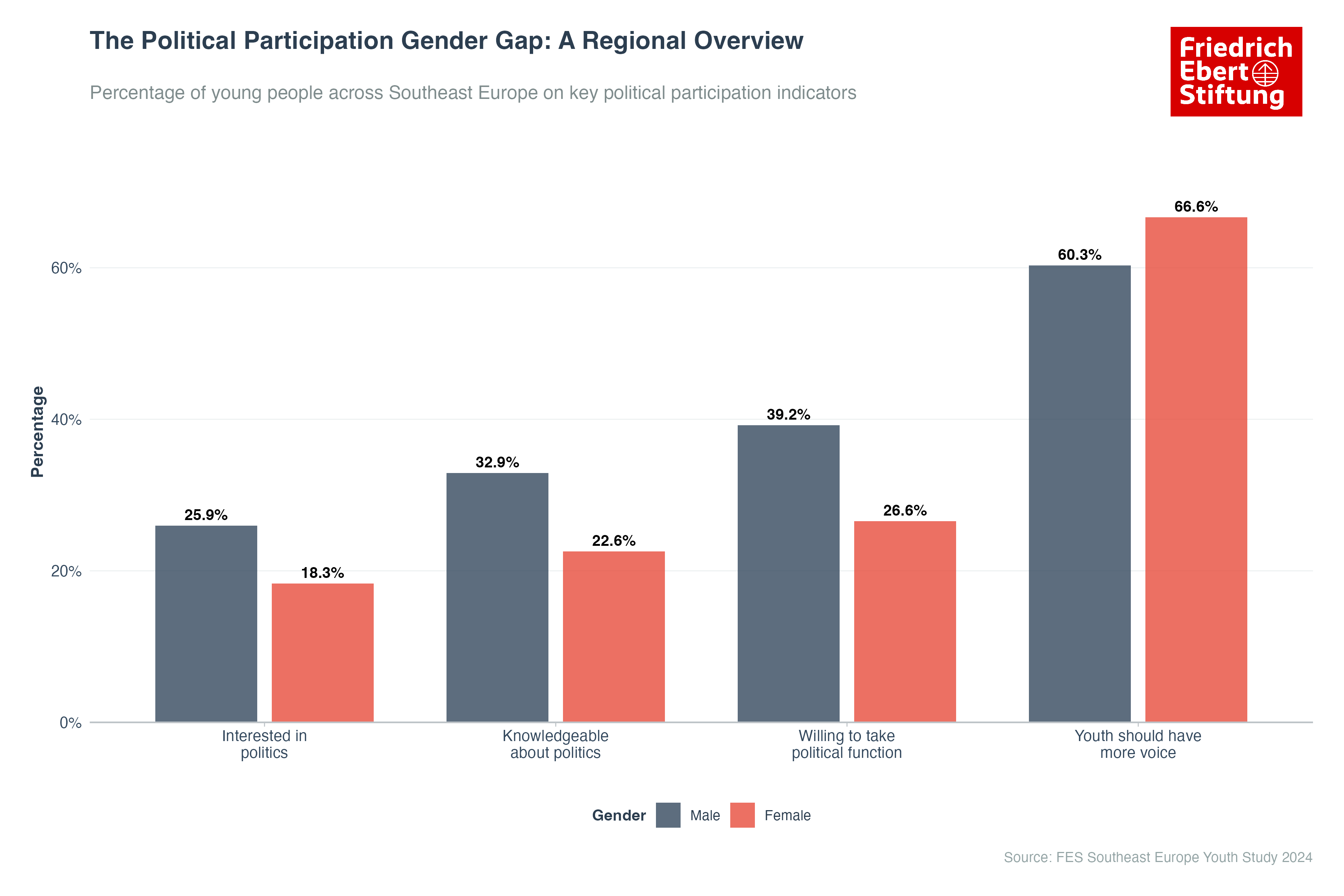
On interest and knowledge, the gaps are moderate but consistent. Asked how interested they are in politics on a scale from "not at all" to "very interested," young men average 2.71 out of 5 while young women average 2.43—both below the midpoint, but with a statistically significant gap of 0.27 points. For self-assessed political knowledge, the gap is slightly larger at 0.33 points: men place themselves at the midpoint of the scale while women sit closer to the lower end. Both gaps persist after controlling for education, age, urban-rural location, and country.
The gap widens considerably when the question moves from attitudes to action. Asked whether they would be willing to take a political function, 39.2% of young men say yes compared to 26.6% of young women—a 12.6 percentage point gap that represents the largest gender divide in this analysis.
But on whether young people should have more possibilities to speak out in politics, the pattern reverses. Two-thirds of young women (66.6%) agree, compared to 60.3% of young men. This 6.4 percentage point gap in women's favour is also statistically significant, and hints at something more complex than simple political disengagement among young women.
It is worth noting what both genders agree on. Young people's interests are poorly represented in national politics—on this, men and women give nearly identical assessments, both averaging closer to "poorly" than to "in between" on the representation scale, with a gap so small as to be substantively meaningless. Both genders, in other words, see the same problem. They differ on their relationship to the political system that produces it.
Political Interest: A Gap That Varies Enormously by Country
The regional average masks enormous variation. In some countries, the political interest gender gap is large. In others, it effectively disappears.
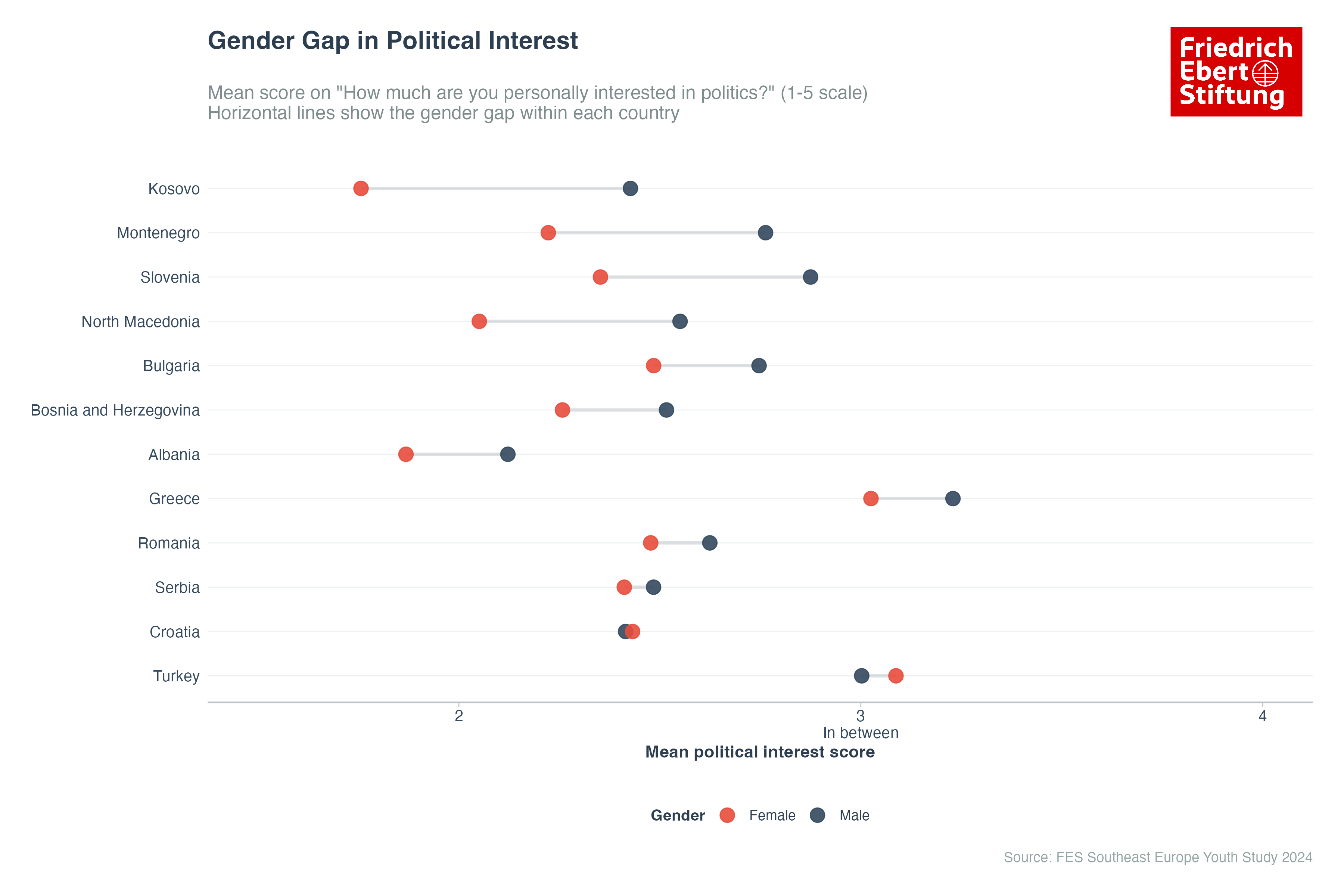
Kosovo shows the largest interest gap in the region: men score 2.43 compared to women's 1.76—a difference of 0.67 points, meaning young Kosovar women express very low political interest even by regional standards. Montenegro (0.54), Slovenia (0.52), and North Macedonia (0.50) also show substantial gaps. In these countries, political engagement appears to be a markedly more male-coded activity among the young.
At the other end, Croatia and Türkiye show no meaningful gender gap at all. In Croatia, women actually score marginally higher than men (2.43 versus 2.41), and in Türkiye both genders report above-average interest with women slightly ahead (3.09 versus 3.00). Greece also shows a narrow gap (0.20), with both genders reporting the highest absolute interest levels in the region—above 3.0 for both men and women.
This variation is statistically significant: the gender gap in political interest is not uniform but depends meaningfully on national context. The countries where the gap is largest do not cluster neatly by EU membership, geography, or economic development, suggesting that country-specific political cultures and gender norms shape whether young women see politics as relevant to their lives.
The Knowledge Gap: Wider, and Differently Distributed
The self-assessed political knowledge gap follows a broadly similar pattern but with slight differences in which countries lead.
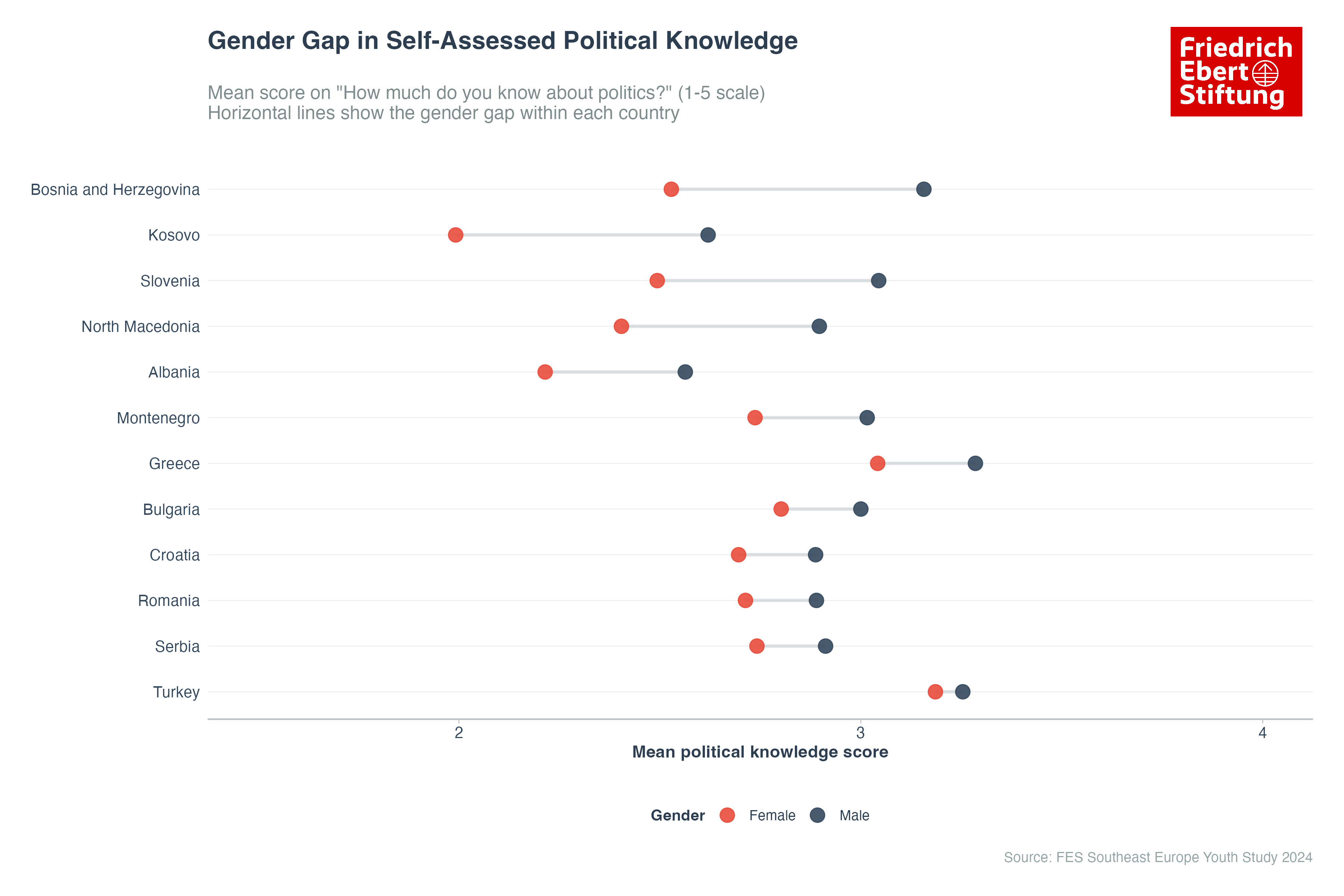
The knowledge gap is wider than the interest gap in most countries. Bosnia and Herzegovina and Kosovo share the largest gap (0.63 points each), followed by Slovenia (0.55) and North Macedonia (0.49). In every country, men rate their political knowledge higher than women—there are no reversals here, unlike the interest measure. In ten of twelve countries the gap is statistically significant. Even Türkiye, where women report slightly higher political interest than men, shows a small knowledge gap in men's favour, though it is not statistically significant.
This raises important questions about what the knowledge gap actually measures. It could reflect genuine differences in political information, but it may also capture differences in confidence. Research on gender and self-assessment consistently finds that women tend to underestimate their own competence relative to men, particularly in domains perceived as masculine. If politics is culturally coded as a male domain across Southeast Europe, the knowledge gap may partly reflect a confidence gap rather than an information deficit.
The Action Gap: Who Would Step Into Politics?
The willingness to take a political function shows the largest and most consistent gender gap in this analysis, and it is here that the practical implications become clearest.
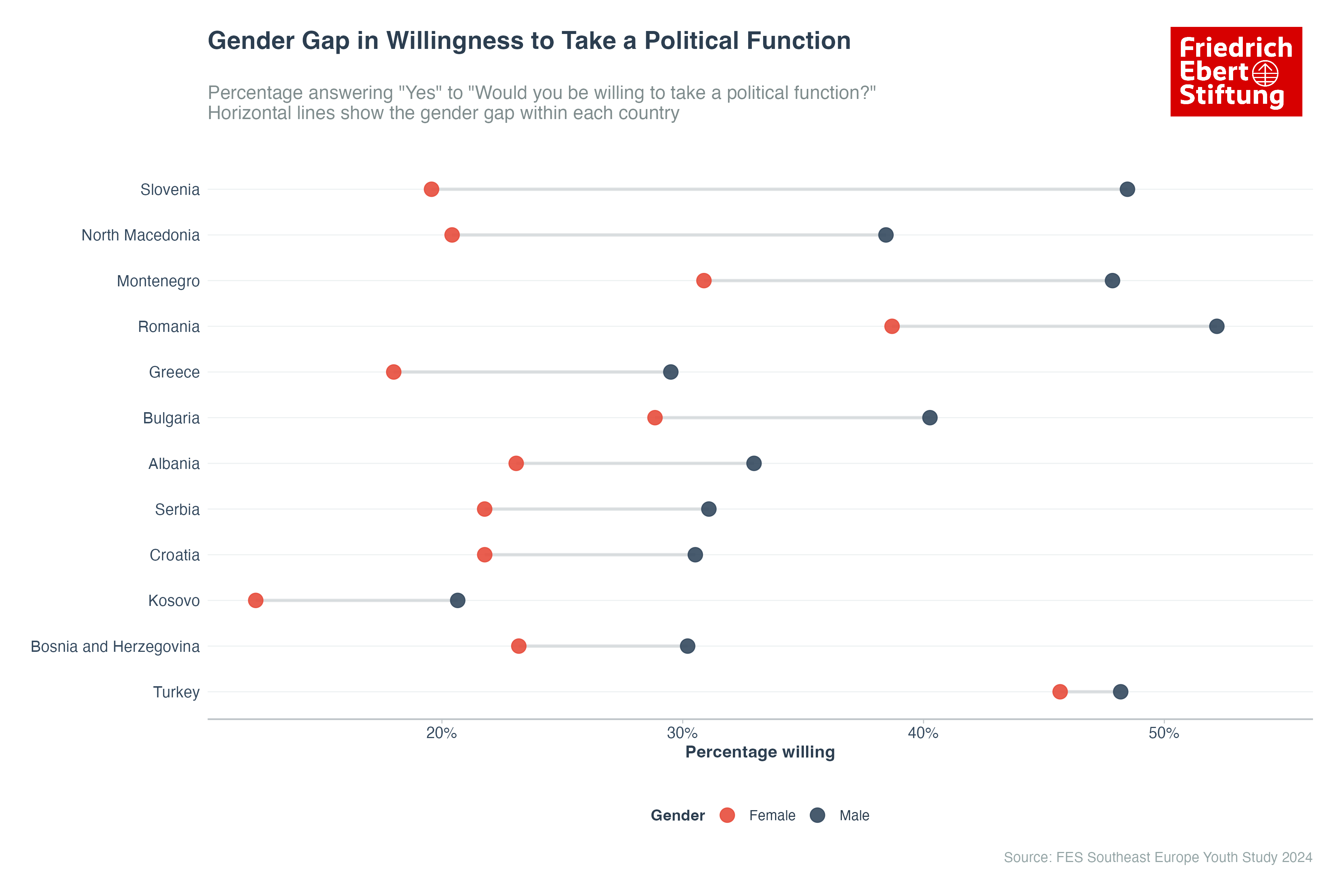
Slovenia stands out with a remarkable 28.9 percentage point gap: nearly half of young Slovenian men (48.5%) would be willing to take a political function, compared to fewer than one in five young women (19.6%). This is one of the largest single gender gaps on any measure in this entire series. North Macedonia (18.0pp) and Montenegro (17.0pp) follow with substantial gaps of their own.
Türkiye, once again, is the exception. There, 48.2% of young men and 45.7% of young women express willingness—a non-statistically-significant gap of just 2.5 percentage points and the highest absolute level of female political ambition in the region. This stands in sharp contrast to countries like Kosovo, where only 12.3% of young women would consider a political role, or Greece, where the figure is 18.0%.
The Reversal: Who Wants Youth to Have More Voice?
Against the backdrop of lower interest, lower self-assessed knowledge, and lower willingness to enter politics, young women are still consistently more likely to agree that young people should have more possibilities to speak out in politics.
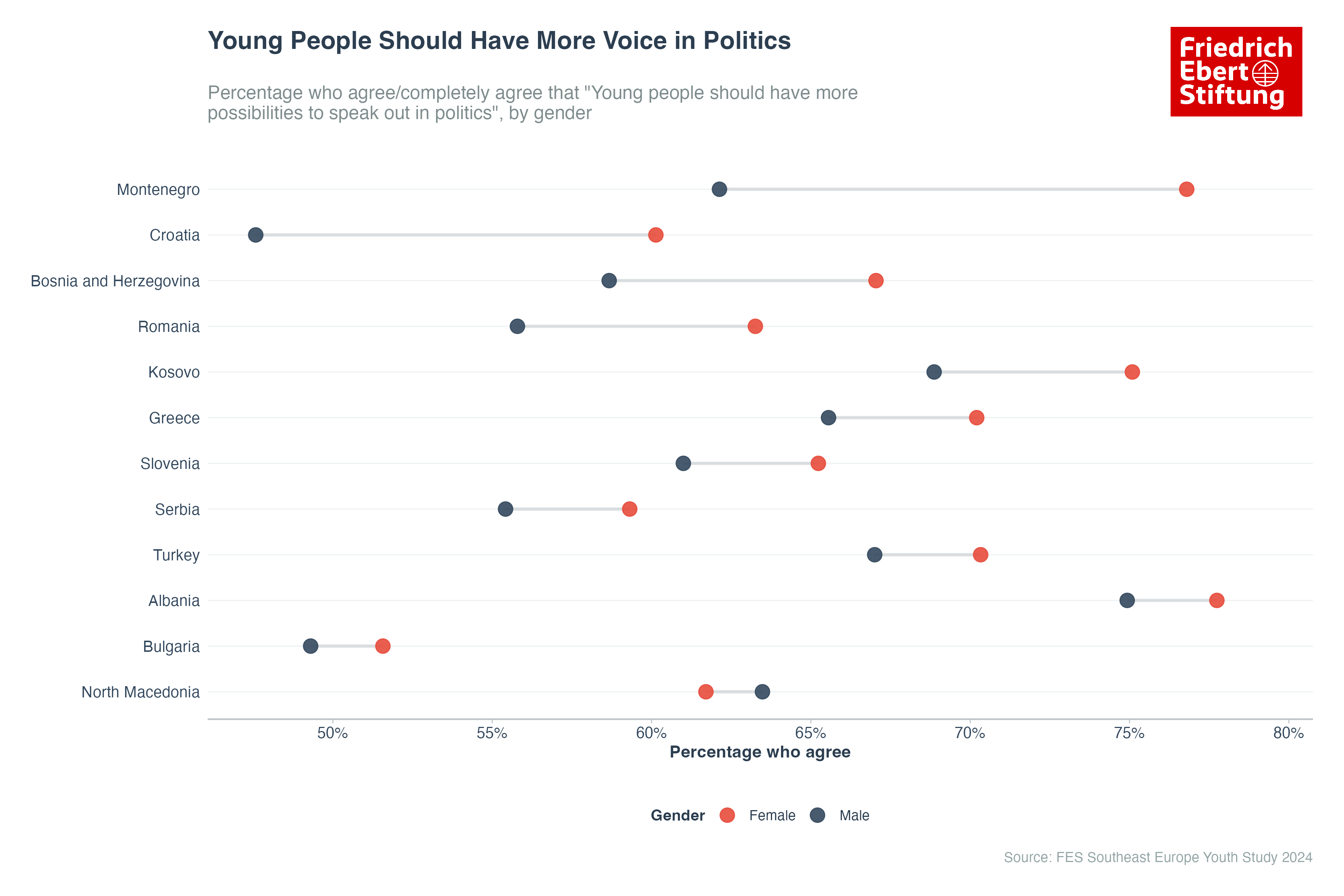
The descriptive pattern points in the same direction in eleven of twelve countries—only North Macedonia shows a slight male-favouring tilt. But at the individual country level, the gap is statistically significant in only three: Montenegro (14.7pp), Croatia (12.6pp), and Romania (7.5pp). In the remaining countries, the female-favouring tendency is too small relative to sample sizes to confirm as statistically reliable. The overall regional pattern is driven by a consistent direction across countries rather than by large, individually significant gaps in each one.
This pattern complicates any straightforward reading of the participation gap as reflecting women's disinterest in politics. Young women are not indifferent to the political sphere—they are, if anything, more vocal about wanting it to be more inclusive. What they report is lower interest in politics as it currently operates, lower confidence in their own political knowledge, and substantially lower willingness to enter the existing political system. But it appears they want that system to change.
One way to read these findings together: young women across Southeast Europe may see the current political system as something that does not work for them, and their lower participation indicators may reflect a rational response to exclusion rather than apathy.
Does Interest Close the Knowledge Gap?
One of the most analytically interesting questions is whether the knowledge gap persists among men and women who are equally interested in politics. If it does, it would suggest that something beyond interest—perhaps confidence, or differential access to political information—is at work.
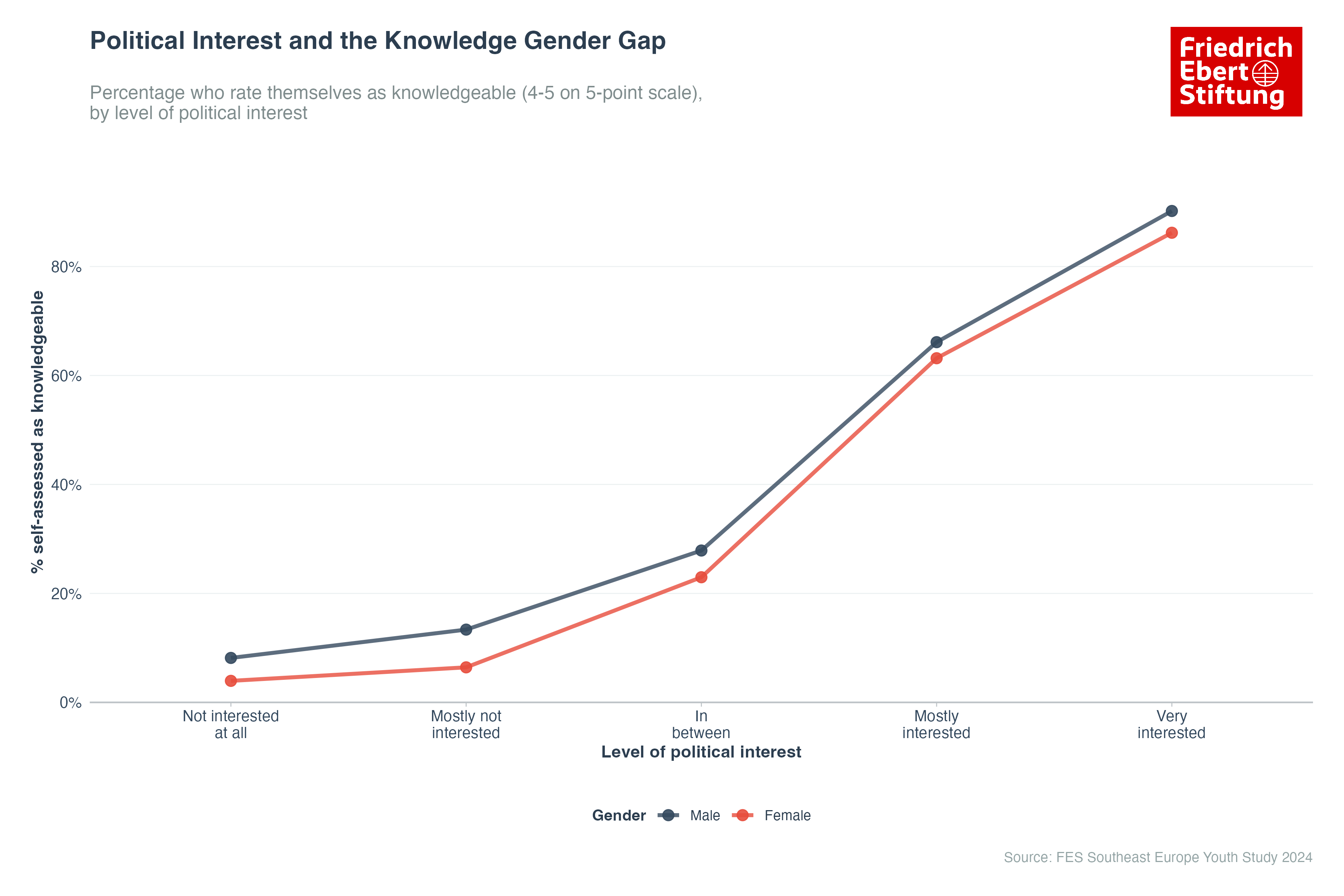
The cross-reference of interest and knowledge reveals that the knowledge gap persists at every level of political interest. Among those who are "very interested" in politics, women are still less likely than men to rate themselves as knowledgeable. The gap does not close even at the highest levels of engagement.
This finding is consistent with the confidence interpretation. If the knowledge gap were purely about information—if women simply knew less because they paid less attention—we would expect the gap to narrow or disappear among those who are equally interested. The fact that it persists suggests that equally engaged young women nonetheless assess their own political competence more cautiously than their male peers.
Whether this reflects actual knowledge differences, socialised modesty, or an accurate assessment of differential access to political networks and information is impossible to determine from survey data alone. But the pattern matters for practical reasons: if young women systematically underestimate their political competence, this may contribute to their lower willingness to enter politics, creating a self-reinforcing cycle where lower confidence leads to lower participation, which in turn limits the political experience that builds confidence.
What the Multivariate Models Show
The statistical models confirm that the gender gaps in interest, knowledge, and willingness to take a political function persist after controlling for age, education level, urban-rural location, and country. Being female is associated with lower political interest (by 0.29 points), lower self-assessed knowledge (by 0.33 points), and substantially lower odds of willingness to take a political function—all highly statistically significant.
Education emerges as a significant predictor: higher education is associated with greater political interest, knowledge, and willingness to take political functions, for both genders. For political interest, the gender gap actually varies significantly by education level, though it remains significant even among the highly educated. For knowledge and political function willingness, the gap is similarly persistent regardless of education. A highly educated young woman still reports lower political interest and knowledge than a highly educated young man, on average.
The Türkiye Exception
Türkiye emerges from this analysis as a consistent outlier. It is the only country where young women report slightly higher political interest than young men. It shows the smallest gender gap in self-assessed knowledge. And it has, by far, the smallest gap in willingness to take a political function—with the highest absolute rate of female political ambition in the region.
Implications
The participation gap is not an engagement gap across the board. Young women are less interested in politics as it exists, less confident in their political knowledge, and less willing to enter political institutions. But they are equally critical of youth representation and more supportive of expanding youth voice in politics. Framing this simply as female political disengagement misses the complexity.
The knowledge-confidence question deserves attention. The persistence of the self-assessed knowledge gap even among equally interested men and women suggests that confidence may be as important as information in shaping the participation gap. Programs aimed at increasing women's political participation may need to address not just political literacy but the confidence to act on it.
Country context shapes everything. The gap in willingness to take a political function ranges from 2.5 percentage points in Türkiye to 28.9 in Slovenia. This variation is too large to be addressed by regional generalisations. Understanding why some political cultures produce near-parity in young women's political ambition while others produce vast gaps is essential for any meaningful intervention.
The pipeline problem is real. With only 12.3% of young women in Kosovo and 18.0% in Greece willing to consider a political function—compared to 45.7% in Türkiye—the supply of young women willing to enter politics varies enormously. Gender quotas and other institutional mechanisms for women's representation may be necessary in the near term, but the underlying attitudinal gaps suggest that structural change alone will not be sufficient without shifts in how young women perceive their own place in the political sphere.
Conclusion
The political participation gender gap across Southeast Europe is real and consistent, but it is not uniform. Where it matters most—in the willingness to actually enter political life—it ranges from negligible to enormous depending on national context. And it coexists with a pattern that undermines simple narratives about female apathy: young women are, across the region, more insistent than young men that youth should have a greater voice in politics.
The challenge, then, is not to make young women more interested in politics in the abstract. It is to make political systems that young women see as worth engaging with—and to address the confidence deficit that may prevent equally interested and informed young women from translating their views into political action.
About the Data
This analysis draws from the Friedrich-Ebert-Stiftung's Southeast Europe Youth Study 2024, examining attitudes among 8,943 young people aged 14-29 across Albania, Bosnia and Herzegovina, Bulgaria, Croatia, Kosovo, North Macedonia, Montenegro, Romania, Serbia, Slovenia, Greece, and Türkiye.
Related publication

Hasanović, Jasmin ; Lavrič, Miran ; Adilović, Emina ; Stanojević, Dragan
Youth study Southeast Europe 2024
independent but concerned: the voices of young people in Southeast Europe
See the full list of youth study publications