
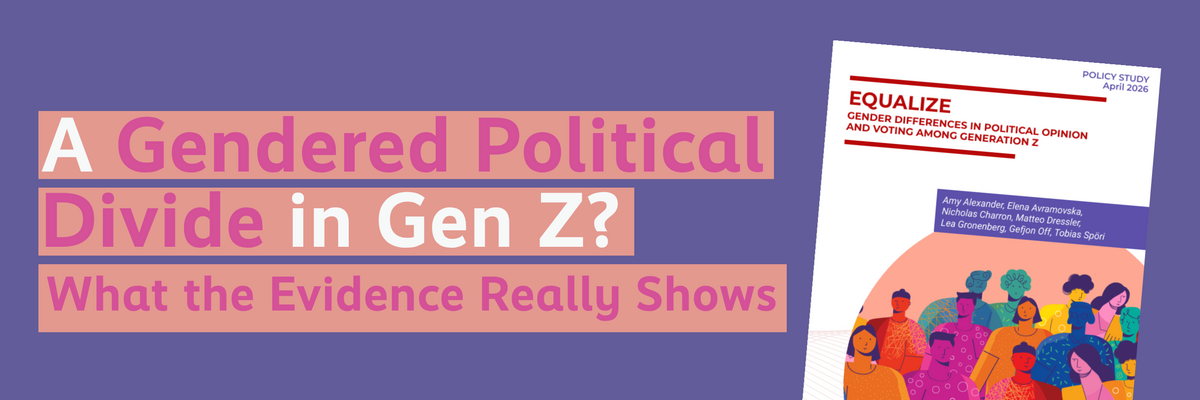
EqualiZe: Gender Differences in Political Opinion and Voting Among Generation Z
Is Gen Z Defined by a Gender Divide?
A growing narrative suggests that Gen Z in Europe is defined by a new political gender divide: young women moving left, young men moving right. But how accurate is this claim? Drawing on European Social Survey (ESS) data across the EU and beyond, alongside focus groups with young people in Germany, Greece, Poland, Spain and Sweden, our new study offers a more nuanced perspective. It finds that gender differences among young Europeans do exist, but they vary significantly across countries and issues. The most consistent gaps emerge in ideological self-placement and attitudes towards gender equality, while differences in voting behaviour are far less pronounced than public debate often assumes.
A Generation Shaped by Shared Insecurity
Rather than pointing to a simple cultural clash between young women and men, the findings highlight a generation shaped by shared insecurity: rising living costs, housing pressures, unstable labour markets, climate anxiety and declining trust in political institutions.
Within this context, young women and men often interpret insecurity differently. Young women tend to connect it to issues of safety, discrimination, autonomy and care responsibilities, while young men more often frame it in terms of opportunity, fairness, recognition and social status. Importantly, while disagreements over feminism exist,
Where the Divide Really Lies
The divide therefore lies less in fundamental values than in differences of salience (what matters most), framing (how issues are understood), and the perceived implications of policy responses. Much of what is described as a “gender divide” is better understood as a divergence in interpretation under shared structural pressures, rather than a deep ideological split.
Strategic Implications for Progressive Politics
For progressive policymakers and communicators, these findings carry important strategic implications:
- Avoid over-framing Gen Z as a polarised gender bloc Narratives of “male backlash” risk overstating divisions and obscuring shared concerns.
- Focus on structural insecurity as the common denominator Housing, labour market entry and economic stability are more powerful drivers of attitudes and political behaviour than cultural conflict alone.
- Reframe gender equality as part of economic and life-course security While support for gender equality is widespread, it can become contested when perceived as zero-sum. Linking it to opportunity, stability and fairness increases resonance across genders.
- Address interpretation gaps, not just attitude gaps The challenge lies not only in what young people believe, but in how they understand fairness, change and responsibility.
Implications for Communication Strategy
For progressive actors, effective messaging should:
- Emphasise shared generational challenges (housing, work, stability, mental wellbeing)
- Avoid framing gender equality as a competition between groups
- Link gender equality to practical life outcomes (security, opportunity, independence)
- Acknowledge different lived experiences without reinforcing division narratives
- Position policy as enabling personal agency within structural support
A Forward-Looking Agenda
By connecting gender equality to economic security, social protection, mental wellbeing, inclusive social norms and effective governance, this study sets out a forward-looking agenda to rebuild trust, expand opportunity and strengthen democratic resilience across generations.
About the Data
EqualiZe is a cooperation of FEPS and Friedrich-Ebert-Stiftung's Vienna Office on Democracy of the Future, as well as ON ETERON and dpart and focuses specifically on the European Union (EU) member state context, allowing us to examine these questions within a broadly shared political and institutional framework. This framework includes common policy developments, such as the Work-Life Balance Directive and the Pay Transparency Directive, both of which have required substantial implementation and policy adaptation across the EU and its member states, making EU member states particularly useful cases for analysis, while also acknowledging and leveraging the significant differences that persist across countries.
The study adopts a mixed-methods approach, combining quantitative and qualitative analyses. It draws on data from all 27 EU member states, as well as Norway, Switzerland, Iceland and the UK, using the latest wave of the European Social Survey (ESS). To provide more detailed insights, the analysis also focuses on five countries selected to reflect Europe's geographical and cultural diversity, particularly regarding historical gender-norm contexts (Germany, Greece, Poland, Spain and Sweden). The quantitative analysis is complemented by qualitative evidence from 17 focus groups conducted with young men and women across these five countries, involving more than 100 participants. Together, these approaches allow for a more nuanced understanding of the mechanisms that may explain why gender divides emerge in some dimensions and contexts but not in others.